
Offshore Accident Lawyer

Over $1 Billion Recovered for Maritime Accident Victims. We are proud to have a reputation for aggressively fighting for the rights of injured workers.

Offshore Injury Lawyers for Gulf Coast Workers — Lambert Zainey Smith & Soso

Working offshore in the Gulf of Mexico — on platforms, rigs, vessels, and helicopters — means working in one of the most hazardous environments in any industry. When a serious accident happens far from shore, injured workers and their families face not just physical recovery but a complex legal framework that determines what compensation they are entitled to and who can be held responsible.

Lambert Zainey is a New Orleans maritime law firm that has represented offshore workers and their families for nearly 50 years. We understand the Jones Act, OCSLA, LHWCA, and general maritime law — and how those frameworks interact in the specific scenarios that arise in Gulf of Mexico offshore work. This page is your starting point for understanding your rights after an offshore injury.

Quick Facts

  • Offshore injuries in the Gulf of Mexico are governed by a complex mix of federal maritime laws — the Jones Act, OCSLA, LHWCA, and general maritime law — and which law applies depends on where you work and your job classification.
  • Multiple parties can be held liable after an offshore accident — your employer, the platform operator, equipment manufacturers, and contractors may all share responsibility.
  • LHWCA/OCSLA workers must notify their employer within 30 days and file a formal claim within one year — significantly shorter than the Jones Act’s three-year deadline.
  • Workers on vessels and moveable rigs typically have Jones Act protections. Workers on fixed platforms are typically covered by OCSLA and the LHWCA.
  • Lambert Zainey has recovered over $1 billion for offshore workers and their families across the Gulf Coast. We have handled cases against the largest oil companies, drilling contractors, and vessel operators in the industry.
  • 2026 note: The Trump administration issued a Jones Act shipping waiver in March 2026. This waiver affects cargo shipping logistics only — it does not change your legal rights as an injured offshore worker.

Why Offshore Workers Trust Lambert Zainey

Choosing the right lawyer after an offshore injury is one of the most important decisions you will make. Here is what sets Lambert Zainey apart:

  • Nearly 50 years representing workers injured in Gulf Coast offshore accidents — including serving as co-lead counsel in the Seacor Power Limitation of Liability litigation, one of the most complex maritime disaster cases in recent Gulf history.
  • Deep knowledge of maritime law — we understand how the Jones Act, LHWCA, OCSLA, Louisiana law, and general maritime rules apply and interact in the specific scenarios that arise offshore.
  • We understand offshore work — the equipment, the operations, the safety standards, and the common dangers on platforms, rigs, vessels, and helicopters.
  • Proven record against major companies — we have a documented history of holding large oil companies, drilling contractors, vessel operators, and service providers accountable. See our case results.
  • Independent investigation — we use engineers, safety experts, and medical professionals to build strong cases and establish exactly what happened.
  • Personal attention — we give every client direct access to their attorney, explain things clearly, and fight for maximum recovery. Learn more about our maritime attorneys.

What Qualifies as an Offshore Injury

An offshore injury is generally an accident that occurs in the Gulf of Mexico or other open waters beyond state waters — typically more than three miles from shore. The work usually involves oil and gas exploration, drilling, or production. Covered scenarios include injuries on:

  • Fixed production platforms attached to the seabed
  • Supply boats, crew boats, and anchor handling vessels
  • Lift boats and jack-up boats
  • Offshore construction barges
  • Helicopters transporting workers to and from offshore sites
  • Mobile Offshore Drilling Units (MODUs) — jack-up rigs, semi-submersibles, drillships
  • Docks and terminals that directly support offshore operations

Which Laws Apply to Your Offshore Injury Claim

Getting hurt offshore is governed by a different legal system than land-based workplace injuries. The law that applies to your claim depends on where you were working and your job classification. Here is what each framework means for you.

The Jones Act

The Jones Act protects seamen — workers whose duties contribute to the function of a vessel and who spend a substantial portion of their time working on a vessel in navigation. Under the landmark Supreme Court ruling in Chandris, Inc. v. Latsis (1995), workers who spend at least 30% of their working time on a vessel generally qualify as seamen.

Under the Jones Act, qualified seamen can sue their employer directly for negligence — a significantly broader right than standard workers’ compensation. Injured seamen are also entitled to maintenance and cure benefits regardless of fault.

2026 note: The Trump administration issued a temporary Jones Act waiver in March 2026 affecting cargo shipping between U.S. ports. This waiver does not affect your legal rights as an injured worker. Your ability to file a Jones Act negligence claim remains fully intact regardless of the waiver.

Deadline: 3 years from the date of injury.

>> Learn About Jones Act Claims

OCSLA and the LHWCA

If you were injured on a fixed platform attached to the seabed on the Outer Continental Shelf, the Outer Continental Shelf Lands Act (OCSLA) most likely governs your claim. OCSLA does two things:

First, it extends LHWCA benefits — federal workers’ compensation covering medical expenses and a portion of lost wages — from your employer, regardless of fault.

Second, it allows you to bring negligence claims against other responsible parties — platform operators, contractors, and equipment manufacturers — using the law of the nearest state (typically Louisiana).

Critical deadline: LHWCA/OCSLA workers must notify their employer of the injury within 30 days and file a formal claim within one year. Missing the 30-day notice requirement can permanently eliminate your right to benefits.

>> Learn About OCSLA Claims

>> Learn About LHWCA Claims

General Maritime Law and Unseaworthiness

General maritime law imposes a duty of care on vessel operators and owners and applies across a wide range of offshore scenarios. It also includes the unseaworthiness doctrine — vessel owners are legally required to provide a vessel that is reasonably fit for its intended purpose. This is a form of strict liability: if the vessel was unseaworthy and that condition caused your injury, the owner can be held liable even without proof of negligence.

>> Learn About Unseaworthiness Claims

Death on the High Seas Act (DOHSA)

When a worker dies in an accident that occurs more than three nautical miles from shore — or more than 12 nautical miles in the case of aircraft accidents — DOHSA governs the family’s wrongful death claim. DOHSA allows recovery for the financial support the deceased would have provided over their working life. It does not allow recovery for the family’s grief, loss of companionship, or the deceased worker’s pre-death pain and suffering — making it significantly more restrictive than most state wrongful death laws. Identifying whether DOHSA applies and how to maximize recovery within its limits is one of the most consequential determinations in an offshore wrongful death case.

>> Learn About DOHSA Claims

Determining which law applies to your specific injury requires an experienced offshore attorney reviewing the facts of your case.

Common Causes of Offshore Accidents

The offshore environment creates hazards that simply do not exist in land-based workplaces. Serious accidents frequently result from:

  • Falls — slipping on wet decks, tripping over equipment, falling from derricks, stairs, or elevated work platforms. See our guide to maritime slip, trip, and fall accidents.
  • Fires and explosions — from blowouts, gas leaks, electrical failures, and unsafe hot work operations. See our post on blast injuries from offshore explosions.
  • Severe weather — being required to work in unsafe conditions, vessel instability, and hurricane-related evacuation injuries. See our post on offshore workers and hurricanes.
  • Transfer accidents — injuries sustained using personnel baskets, swing ropes, or gangways when moving between vessels and platforms. See our vessel transfer accidents page.
  • Vessel collisions — between supply boats, crew boats, or vessels striking platforms.
  • Chemical and toxic exposure — drilling muds, H2S gas, and other hazardous materials.
  • Helicopter accidents — from mechanical failure, pilot error, or adverse weather. See our offshore helicopter accidents page.
  • Equipment failure — cranes, winches, drilling equipment, and safety systems breaking down due to inadequate maintenance.
  • Struck-by and caught-in accidents — falling tools or pipe, swinging crane loads, moving machinery, and high-pressure line failures.
  • Crew distraction and negligence — including cell phone distraction.

These accidents frequently cause catastrophic injuries — traumatic brain injury, spinal cord damage, severe burns, amputations, or death. A significant number are linked to what OSHA calls the Fatal Four hazards.
Louisiana offshore accident attorney

Types of Offshore Structures and Vessels We Handle

Lambert Zainey handles injury cases involving all types of offshore equipment used in Gulf operations:

  • Fixed production platforms
  • Jack-up rigs and semi-submersible rigs
  • Drillships
  • Supply boats and offshore support vessels
  • Crew boats
  • Lift boats and jack-up boats
  • Anchor handling vessels
  • Dive support vessels
  • Pipe-laying barges
  • Offshore helicopter
  • FPSOs (Floating Production Storage and Offloading units)

What to Do Immediately After an Offshore Injury

The steps you take in the hours and days after an offshore injury directly affect your ability to recover full compensation. Here is what to prioritize.

  • Step 1: Seek medical attention immediately. Your health is the priority. Get a full medical evaluation and tell the treating physician exactly how the accident happened. Many serious offshore injuries — particularly from blasts, falls, and vessel collisions — do not produce immediate symptoms. A continuous medical record starting from the date of injury is critical evidence. See our guide to medical tests for offshore injuries.
  • Step 2: Report the injury in writing. Notify your supervisor or company representative as soon as possible and ensure a written incident report is completed. For LHWCA/OCSLA workers, the 30-day notice requirement is strict — missing it can permanently eliminate your right to benefits.
  • Step 3: Do not sign anything or give recorded statements. The company’s insurance adjusters and legal team begin working immediately after an offshore accident to limit their exposure. Do not give a recorded statement, sign any document, or accept any settlement offer before speaking with a maritime attorney.
  • Step 4: Document everything you can. Note who witnessed the accident, what equipment was involved, and what the conditions were. Photograph injuries and the scene if you can safely do so. Write down the details while your memory is fresh.
  • Step 5: Contact Lambert Zainey. Maritime injury claims involve strict deadlines — some as short as 30 days. The sooner you have experienced legal representation working on your behalf, the better protected your claim will be. Contact us for a free, confidential consultation.

Compensation Available in Offshore Injury Claims

Depending on which law applies and the severity of your injuries, you may be entitled to recover:

  • Medical expenses — all current and future treatment costs
  • Lost wages — income lost during recovery and reduced future earning capacity
  • Pain and suffering — available in Jones Act and negligence claims; generally not available through LHWCA benefits alone
  • Disability and disfigurement — permanent physical limitations and scarring
  • Maintenance and cure — daily living expenses and medical coverage for Jones Act seamen, regardless of fault
  • LHWCA benefits — medical and wage replacement for platform workers, regardless of fault
  • Wrongful death damages — for families of workers who did not survive, governed by DOHSA or state law depending on where the accident occurred

Offshore Accident Types We Handle

Lambert Zainey has deep experience with all types of offshore accidents in the Gulf of Mexico. Learn more about specific accident types:
  • Oil Rig Accidents — drilling rig injuries, explosions, fires, and equipment failures
  • Lift Boat Accidents — capsizings, instability, and crew injuries on jack-up boats
  • Vessel Transfer Accidents — injuries during personnel transfers between vessels and platforms
  • Helicopter Accidents — crashes and injuries during offshore helicopter transport
  • Platform Accidents — falls, explosions, and equipment failures on fixed production platforms
Jones Act offshore
case results

Over $1 Billion Recovered for Maritime Accident Victims
Murphy Oil Spill
$330 MILLION SETTLEMENT

Oil storage tank rupture at the Murphy Oil USA refinery in Chalmette, LA. The fastest class certification and resolution of a case of its type and magnitude to date.

ARCO Explosion
SETTLED IN ONLY 12 MONTHS

Arco cryogenic platform explosion caused by improper cold cut of Southern Natural Gas pipeline. Settlement for the injured and deceased in approximately twelve months.

Common Questions About Offshore Injury Claims

Working offshore near New Orleans comes with risks, and accidents can happen. This section answers common questions to help you understand your rights and what to do after an injury.

Most workers on fixed platforms do not qualify as Jones Act seamen because fixed platforms permanently attached to the seabed are generally not considered vessels under maritime law. Your claim is more likely governed by OCSLA, which extends LHWCA workers’ compensation benefits and allows third-party negligence claims against operators, contractors, and equipment manufacturers. Whether you qualify as a seaman is a fact-specific determination that depends on the nature of your work and how much time you spend on vessels versus fixed structures. An experienced maritime attorney can evaluate your situation and identify which legal framework gives you the strongest claim.

If you qualify as a Jones Act seaman, yes — you can sue your employer directly for negligence. If you are covered by LHWCA/OCSLA, you generally cannot sue your employer directly, but LHWCA provides no-fault workers’ compensation benefits and you can pursue separate negligence claims against other responsible parties — the platform operator, equipment manufacturers, or contractors. In many offshore accidents, multiple parties share liability and claims can be pursued against all of them simultaneously.

It depends on where you were injured — vessel versus fixed platform — your job classification, and in some cases how the injury occurred. Workers on vessels, moveable rigs, and lift boats are more likely covered by the Jones Act. Workers on fixed platforms are typically covered by OCSLA and the LHWCA. Workers on vessels operating near platforms may have claims under multiple frameworks simultaneously. Because the answer significantly affects both what you can recover and what deadlines apply, this determination should be made by an experienced offshore attorney as soon as possible after the accident.

Talk to a maritime attorney first. The adjuster represents the company’s financial interests, not yours. Their goal is to limit what the company pays. Do not give a recorded statement, sign any document, or accept any offer before getting independent legal advice.

Filing deadlines depend on which law governs your claim. Jones Act and general maritime law claims generally allow three years from the date of injury. LHWCA/OCSLA claims require written notice to your employer within 30 days and a formal claim filed within one year. Third-party negligence claims under Louisiana law through OCSLA have a one-year deadline. Because these deadlines differ significantly and missing them permanently eliminates your rights, contact a maritime attorney as soon as possible after the accident — do not wait until you know how serious your injuries are.

Federal anti-retaliation statutes make it illegal for an employer to retaliate against maritime workers for filing an injury claim. If your employer threatens your job, reduces your hours, or terminates you after you report an injury or hire an attorney, they may face additional liability.

No. The March 2026 Jones Act waiver issued by the Trump administration affects cargo shipping logistics — specifically, it allows foreign-flagged vessels to transport goods between certain U.S. ports. It does not affect the legal protections available to injured maritime workers. Your right to file a Jones Act negligence claim, your entitlement to maintenance and cure, and all other maritime injury protections remain fully intact.

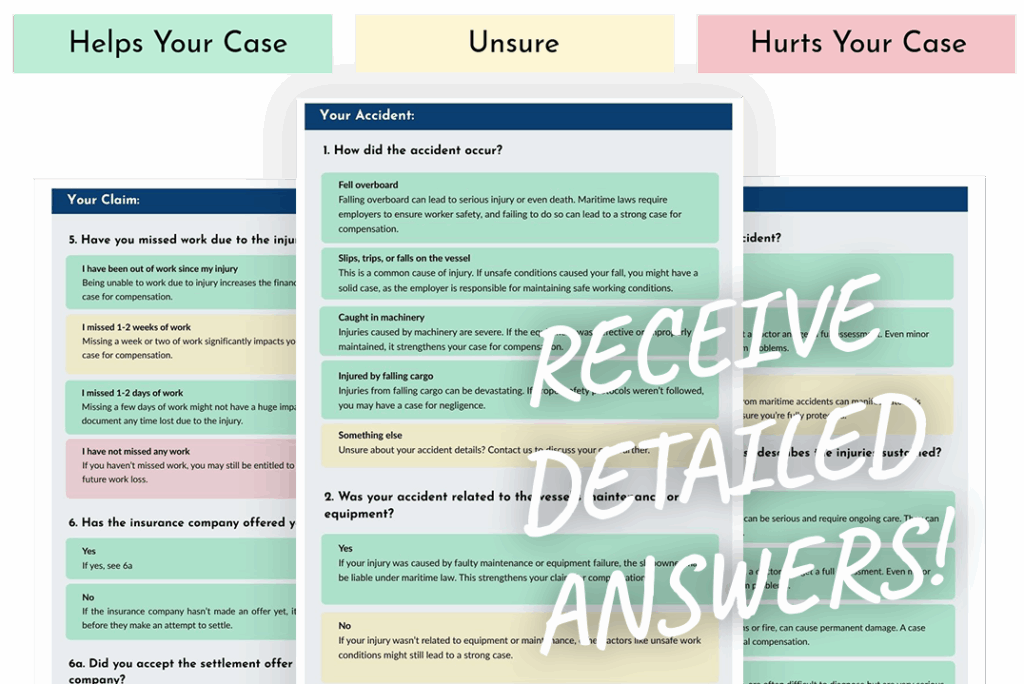
Do I Have A Case? Quiz

Do you want to know if the details of your Maritime Accident HELP or HURT your case?

Take our short quiz to find out.
quizkey graphic2b

Contact Our Offshore Injury Lawyers

If you were injured working in the Gulf of Mexico, you deserve experienced legal representation that understands the specific laws, the specific industry, and the specific challenges of offshore injury litigation.

What Lambert Zainey brings to your case:

  • Nearly 50 years of offshore injury litigation across the Gulf Coast
  • Over $1 billion recovered for injured workers and their families
  • Experience across every legal framework — Jones Act seamen, OCSLA platform workers, vessel crews, and wrongful death claims
  • Proven track record against the largest companies in the oil and gas industry

Your consultation is free, private, and there is no obligation.

What Our Clients’ Say About Us

NATIONALLY RECOGNIZED ATTORNEYS

CONTACT US

Our experienced attorneys are here to guide you through every step of the process, from initial consultation to settlement or trial.

Free Case Review

Fill out the form below to contact Lambert Zainey and schedule a free, confidential consultation and discuss your case with an experienced attorney.