
Free Confidential Consultation
Hurt Offshore? Don’t Sink Your Claim!
Avoid These 5 Costly Mistakes After Your Maritime Accident
Get Your FREE Guide from Lambert Zainey’s Experienced New Orleans Maritime Lawyers
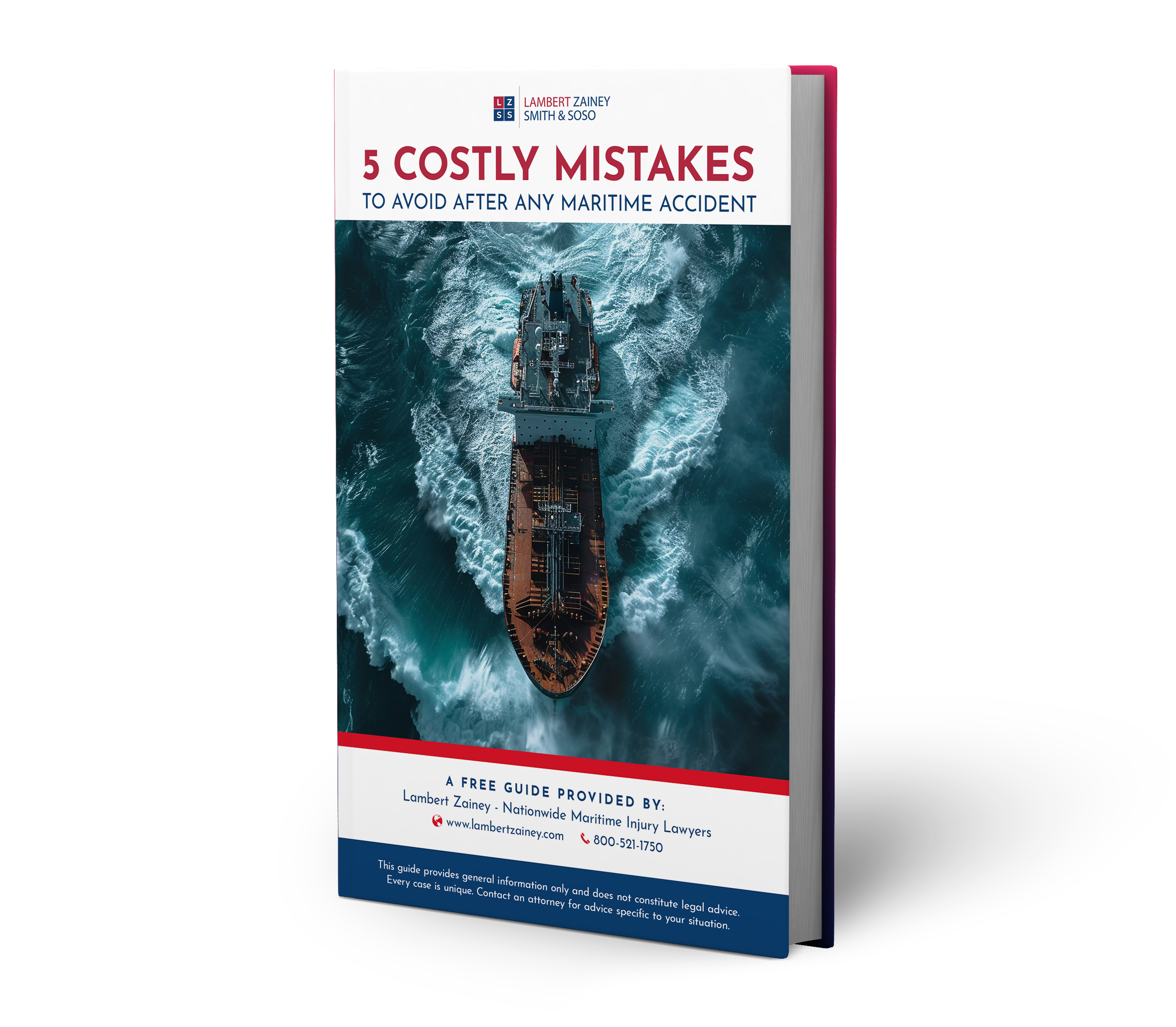
Don’t Risk Your Claim!
Avoid These 5 Costly Mistakes After Your Maritime Accident
Get Your FREE Guide from Lambert Zainey’s Experienced New Orleans Maritime Lawyers
Working offshore, on rivers, or in ports is dangerous. Getting hurt on the job affects your health and your wallet. When an accident happens, knowing what not to do is just as important as knowing what to do.
Simple missteps made in the stressful days following a maritime injury can severely damage your ability to recover fair compensation under complex laws like the Jones Act or LHWCA.
Below you will find the five mistakes we see most often, why each one hurts your claim, and what to do instead. You can also download the full illustrated guide to keep, print, or share with a coworker.
Inside, You’ll Learn:
Mistake 1: Giving a Recorded Statement Before You Talk to a Lawyer
Soon after your injury, someone from your company or their insurance adjuster will contact you. They will be friendly. They will ask for a quick recorded statement just to understand what happened.
Why This Hurts Your Claim
The adjuster’s job is to protect the company’s money, not to help you. They are trained to ask questions in ways that produce answers useful to the company. Your words can be taken out of context later to suggest the accident was your fault, that your injuries are not serious, or that the incident was not work-related.
There is also a timing problem. In the days right after an injury you may be in pain, on medication, or unclear on details. A statement given under those conditions can contain small inconsistencies, and those inconsistencies get used against your credibility later.
What to Do Instead
Report your injury promptly to your supervisor or company according to their procedures. That is required and you should do it.
But politely decline to give a recorded statement to anyone, especially an insurance adjuster, until you have spoken with a maritime lawyer. You can simply say: “I need to focus on my medical treatment right now, and I will consult with counsel before providing any detailed statements.”
Mistake 2: Signing Documents You Do Not Fully Understand
Your employer or their insurer may present you with documents to sign shortly after an accident, sometimes along with a small immediate payment. Be extremely cautious.
Why this hurts your claim
Some documents contain clauses releasing the company from all future liability related to your injury, even if your condition worsens or requires more treatment later. Signing one of those can permanently end your ability to recover. You may also unknowingly sign away specific rights, such as your right to maintenance and cure benefits or your right to bring a claim under the Jones Act.
Early settlement offers are almost always far below the true value of a claim, because they are made before anyone knows the full extent of your injuries or what your future medical needs will cost.
What to do instead
Never sign anything you do not fully understand. Do not sign a settlement agreement or release without having your own independent maritime lawyer review it first. Request copies of any document you are asked to sign, and say plainly that you need time to review it or have counsel review it.
Mistake 3: Downplaying Your Injuries
Whether you are talking to your supervisor, the company doctor, or a coworker, there is often pressure to minimize what happened or tough it out. Some of that pressure comes from the people around you. Some of it comes from yourself.
Why this hurts your claim
It hurts you medically first. If you do not report all your symptoms, your doctors cannot accurately diagnose or treat you, which leads to worse care and a longer recovery.
It hurts you legally second. If you say you feel fine or call an injury minor, and then later require significant treatment or time off work, the company will point to your own earlier words to argue the injury is not serious or was not caused by the accident.
What to do instead
Report every symptom, ache, and pain to your medical providers, even ones that seem minor. Tell them exactly how the injury happened.
You may have to see a company doctor first, but as a seaman you generally have the right to choose your own physician for cure purposes. Use it. Get evaluated by doctors focused on your recovery rather than on the company’s exposure.
Mistake 4: Delaying Treatment or Skipping Appointments
Injured workers sometimes put off treatment, miss follow-up appointments, or stop going to physical therapy. Life gets in the way, transportation is difficult, or they assume they are healing fine.
Why this hurts your claim
Delaying treatment can worsen your condition and slow your recovery. That is the health cost.
The legal cost is that insurance companies will argue that if you did not seek treatment promptly or did not follow medical advice, your injury must not have been serious, or that whatever problems you have now were caused by your failure to treat rather than by the accident. Consistent medical records documenting your injury and progress are among the strongest evidence in a claim. Gaps in those records create doubt.
What to do instead
Seek medical attention promptly after any injury. Attend every scheduled appointment with doctors, specialists, and therapists. Follow your treatment plan, including medications, exercises, and work restrictions.
If something is genuinely preventing you from attending appointments, such as transportation or scheduling, tell your doctor and your attorney. Do not simply skip them.
Mistake 5: Waiting Too Long to Call a Maritime Lawyer
Many injured workers wait. They think they can handle it themselves, or they want to see how badly they are hurt first, or they trust the company to do the right thing.
Why this hurts your claim
There are strict deadlines. Most Jones Act and general maritime claims must be filed within three years, but LHWCA deadlines are far shorter: you must report the injury within 30 days and file a formal claim within one year. Missing a deadline ends your claim regardless of how strong it was. See our post on the Jones Act statute of limitations for the full picture.
Evidence also disappears. Witnesses move or forget. Faulty equipment gets repaired or thrown away. Vessel logs become harder to obtain. Early investigation is often what makes or breaks a case.
And an attorney involved early can stop you from making the first four mistakes on this list, and make sure rights like maintenance and cure are honored from the start. Your employer and their insurer have lawyers working from day one. You should too.
What to do instead
Talk to a maritime lawyer as soon as possible after any significant injury, even if you are unsure whether you have a case. Lambert Zainey offers free consultations, and there is no fee unless we recover for you.
One More: Be Careful What You Post Online
Insurance companies monitor the social media accounts of people with open claims. A photo of you at a family cookout, a post about a weekend trip, or an offhand comment about the accident can be pulled out of context and used to argue your injuries are not as bad as you say.
The safest approach while your claim is pending is not to post about your injury, your recovery, or your activities at all.

Which Law Applies to Your Injury
Which law covers you depends on where you work, and the deadlines are very different. This matters more than most injured workers realize, because Mistake 5 is usually a deadline problem.
Not sure which one describes you? That is common, and it is one of the first things we sort out in a free consultation. For a fuller walkthrough of what to do in the first days after an injury, see our step-by-step guide for injured maritime workers.
Get the Guide to Keep
Everything above is also available as a free illustrated guide you can download, print, or share with a coworker. If you know someone working offshore or on the docks, it is worth passing along before they need it.
What Our Clients’ Say About Us
NATIONALLY RECOGNIZED ATTORNEYS






CONTACT US
Our experienced attorneys are here to guide you through every step of the process, from initial consultation to settlement or trial.
Free Case Review
Fill out the form below to contact Lambert Zainey and schedule a free, confidential consultation and discuss your case with an experienced attorney.