
- Blast injuries affect multiple body systems at once — and symptoms can be delayed for hours or days after the explosion.
- Workers on offshore platforms and refineries have legal rights under maritime law, OCSLA, and federal safety regulations regardless of how the explosion was caused.
- Most civilian doctors have limited experience diagnosing blast injuries. Tell your doctor specifically that you were exposed to a blast wave.
- Employers and platform operators are legally required to prevent the conditions that cause explosions. When they fail, you can pursue compensation for medical costs, lost wages, and pain and suffering.
- Early settlement offers after a blast injury almost never reflect the true long-term cost of your injuries. Do not sign anything before speaking with a maritime attorney.
Fire, intense heat, falling debris, and toxic chemical release are not the only dangers of an offshore or refinery explosion. When an explosion occurs on an offshore oil rig or in a refinery, it generates an invisible pressure wave — called a blast wave — that expands outward in all directions with destructive force.
A blast wind — a forced flow of superheated air — can also be generated during the explosion.
These events are particularly dangerous because a single explosion can inflict life-threatening, multi-system injuries on several workers simultaneously — even workers who are not near the fire or debris field.
What Causes Offshore and Refinery Explosions
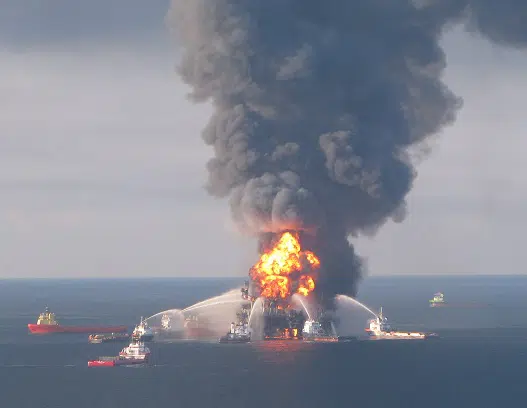
Offshore and refinery explosions are almost always the result of preventable failures — not unavoidable accidents. The most common causes:
Blowouts — Loss of well pressure control allows oil and gas to escape and ignite. The Deepwater Horizon disaster in 2010 is the most well-known example, but smaller blowouts occur in the Gulf of Mexico every year.
Equipment failure — Failed pressure relief valves, malfunctioning blowout preventers, corroded pipelines, and defective electrical systems create conditions where flammable gases accumulate and ignite.
Ignition sources — Sparks from welding and cutting operations, open flames, electrical arcing, and static discharge from inadequately grounded equipment can trigger an explosion when flammable gases are present.
Inadequate maintenance — When operators defer maintenance to cut costs or miss required inspections, the risk of catastrophic failure increases significantly.
Human error — Improper hot work permitting, failure to test for flammable gases before beginning work, and inadequate lockout/tagout procedures contribute to many explosion incidents.
Understanding the cause of the explosion is central to establishing who is liable. The Bureau of Safety and Environmental Enforcement (BSEE) sets and enforces federal safety standards for offshore oil and gas operations and investigates explosion incidents on the outer continental shelf.
What Are Blast Wave Injuries?
A blast injury is physical damage to the body caused by the pressure wave from an explosion hitting the body’s surface. Two factors determine how serious the injury is:
- How close the worker was to the blast
- How powerful the explosion was
According to the CDC, blast injuries are normally only encountered in combat or terrorist attacks. Because they happen so rarely outside those settings, most civilian medical professionals lack the training and experience to effectively diagnose, treat, and manage them.
This is why it is critical to tell your treating physician exactly what happened — including that you were exposed to a blast wave.
The Four Types of Blast Injuries
Blast injuries fall into four categories. A single explosion can cause injuries in more than one category simultaneously.
Primary Blast Injuries
Caused by: The pressure wave itself hitting the body surface
Most affected: Gas-filled structures — lungs, GI tract, middle ear
Primary injuries include:
- Blast lung (pulmonary barotrauma)
- Eardrum rupture and middle ear damage
- Abdominal hemorrhage and perforation
- Eyeball rupture
- Concussion and traumatic brain injury with no external signs of trauma
Blast lung is one of the most dangerous primary injuries. The force of the pressure wave causes hemorrhaging inside the lung, leading to severe respiratory failure — sometimes fatally.
Offshore workers face heightened risk from primary blast injuries because platforms and rigs have numerous confined spaces — pump rooms, compressor rooms, enclosed decks — where blast waves reflect off walls and amplify. According to CDC blast injury guidance, explosions in confined spaces produce significantly more severe primary blast injuries than open-air explosions.
Secondary Blast Injuries
Caused by: Flying debris striking the body
Most affected: Any part of the body
Secondary injuries include penetrating and blunt trauma from shrapnel, equipment fragments, and structural debris.
Tertiary Blast Injuries
Caused by: The victim being thrown by the force of the blast
Most affected: Any part of the body
Tertiary injuries include penetrating and blunt trauma, fractures, and head injuries from impact with surfaces or equipment.
Quaternary Blast Injuries
Caused by: Everything else related to the explosion — not the blast wave itself
Most affected: Any part of the body
Quaternary injuries include burns, crush injuries, traumatic brain injuries, and respiratory damage from smoke inhalation.
What Parts of the Body Are Affected
Blast injuries can damage virtually any body system. Here is what to watch for:
|
Body System |
Injuries |
|---|---|
|
Auditory |
Eardrum rupture, cochlear damage, hearing loss |
|
Circulatory |
Cardiac contusion, shock, air embolism, peripheral vascular injuries |
|
Brain and nervous system |
Concussion, traumatic brain injury, stroke, spinal cord injury |
|
Digestive tract |
Bowel perforation, hemorrhage, ruptured liver or spleen, sepsis |
|
Extremities |
Burns, amputations, fractures, crush injuries, compartment syndrome |
|
Eyes and face |
Perforated eyeball, orbital fractures, foreign body penetration |
|
Kidneys |
Contusion, laceration, acute renal failure |
|
Respiratory |
Blast lung, hemothorax, pneumothorax, pulmonary hemorrhage, sepsis |
Do Not Wait to Seek Medical Attention
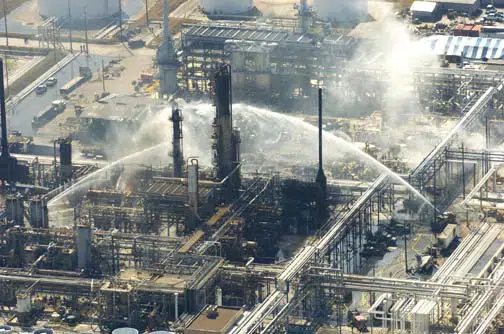
If you were near an explosion — even if you feel fine — seek emergency medical treatment immediately.
Why it matters medically: Many blast injuries are internal and produce no immediate pain. Blast lung symptoms can take up to 48 hours to appear. Without prompt evaluation, a life-threatening injury can go untreated.
Why it matters legally: Gaps in your medical record are one of the most common tools insurers use to minimize your claim. They will argue your injuries were not serious — or were caused by something else — if you waited to see a doctor.
What to tell the doctor: Say specifically that you were exposed to a blast wave. A standard trauma evaluation may miss primary blast injuries. Your doctor needs to know to look for them.
Who Can Be Held Responsible
When an offshore or refinery explosion injures a worker, multiple parties may share liability. Here is who an experienced attorney will investigate:
- The platform or facility operator: Responsible for maintaining safe conditions, functioning safety systems, and proper blowout prevention. If they cut corners on maintenance or ignored known hazards, they can be held liable.
- Equipment manufacturers: If a defective valve, pressure relief system, or blowout preventer contributed to the explosion, the manufacturer can be held liable through a product liability claim — even without proving negligence. You only need to show the equipment was defective and caused the harm.
- Maintenance and inspection contractors: If recent service on failed equipment was inadequate or a known problem was missed during inspection, the contractor bears responsibility.
- Your employer: Jones Act seamen can sue their employer directly for negligence. Workers covered by OCSLA and the LHWCA generally cannot sue their employer directly but can pursue third-party claims against operators, manufacturers, and contractors.
- Engineering and design firms: If a design flaw made an explosion more likely or more severe, the firm that designed the platform, vessel, or equipment may bear responsibility.
In most offshore explosion cases, multiple parties share responsibility. An experienced attorney will investigate all of them simultaneously — not just the most obvious one.
Your Legal Rights After an Offshore or Refinery Explosion
The laws that apply to your claim depend on where you work and your job classification. Here is what each framework means for you.
If you work on a fixed offshore platform — OCSLA applies
Your claim is most likely governed by the Outer Continental Shelf Lands Act (OCSLA). OCSLA applies the law of the adjacent state to negligence claims against platform operators and guarantees LHWCA workers’ compensation benefits from your employer.
What you can recover: Medical expenses, lost wages, pain and suffering, and wrongful death compensation for surviving family members.
⚠️ Critical deadline: LHWCA/OCSLA claimants must notify their employer within 30 days of injury and file a formal claim within one year. This is significantly shorter than the Jones Act’s three-year deadline. Missing the 30-day notice requirement can eliminate your right to benefits entirely.
If you qualify as a seaman — the Jones Act applies
Under the Jones Act, you can file a negligence claim directly against your employer. You can also pursue an unseaworthiness claim if the vessel or platform was not in a reasonably safe condition.
What you can recover: Medical expenses, lost wages, future earning capacity, pain and suffering, and mental anguish.
You are also entitled to maintenance and cure benefits — daily living expenses and medical coverage — from the date of your injury regardless of fault.
Deadline: Three years from the date of injury.
If you work at a land-based refinery — state law applies
Your claim may fall under state workers’ compensation law as well as third-party negligence claims against equipment manufacturers, maintenance contractors, or other parties whose failures contributed to the explosion.
What your damages should cover — regardless of which law applies:
- All current and future medical treatment — including specialist care for blast lung, hearing loss, and traumatic brain injury that may not fully manifest for weeks or months
- Lost wages during recovery and lost earning capacity if you cannot return to your prior occupation
- Pain, suffering, and emotional distress including PTSD, which is common among explosion survivors
- Long-term care costs if your injuries result in permanent disability
Do not accept any settlement offer or sign any documents before speaking with an attorney. Early offers rarely reflect the true long-term cost of blast injuries.
The offshore injury attorneys at Lambert Zainey have spent nearly 50 years representing workers injured in offshore and refinery explosions across the Gulf Coast. Contact us today for a free, confidential consultation.
Frequently Asked Questions
Get Our FREE Guide to Protect Your Claim
What you do after an accident is critical. Insurance companies will try to get you to make mistakes that can hurt your claim. Our free guide can help you avoid these traps.
Download our complimentary guide: “5 Costly Mistakes to Avoid After Any Maritime Accident” to arm yourself with the knowledge you need to protect your rights.
Injured in an Offshore or Refinery Explosion? Here Is What to Do Next.
A blast injury changes everything — your health, your ability to work, your family’s financial security. The physical recovery is hard enough without also navigating a legal system that the companies involved have been preparing for since before you left the hospital.
What Lambert Zainey brings to your case:
- Nearly 50 years representing offshore workers and their families across the Gulf Coast
- Over $1 billion recovered — not by settling quickly, but by investigating thoroughly and refusing to accept less than what clients are truly owed
- Experience across every framework — Jones Act seamen, fixed platform workers, refinery employees, and families of workers who did not survive
The companies involved have legal teams working right now. You deserve the same.
Contact Lambert Zainey today for a free, confidential consultation — no fees unless we recover for you.