

Vessel Transfer Accidents
Over $1 Billion Recovered for Maritime Accident Victims. We are proud to have a reputation for aggressively fighting for the rights of injured workers.
Offshore Vessel Transfer Accident Lawyers — Lambert Zainey Smith & Soso
Moving workers between supply boats, crew boats, and offshore platforms is one of the most dangerous routine operations in Gulf Coast offshore work. Personnel baskets, swing ropes, and gangways are the tools that make this possible — and when any of them fails, the consequences can be catastrophic.
According to BSEE’s offshore incident statistics, lifting incidents — the category that includes personnel basket and crane transfer operations — are the single most common type of incident on the Outer Continental Shelf, with 375 reported in 2023 and 333 in 2022. These numbers exceed fires, explosions, gas releases, and collisions combined. The risks are not theoretical. They are documented, recurring, and in most cases preventable.
When a vessel transfer accident injures a worker, the question is not whether someone was at fault. In most cases someone was. The question is who — and which legal framework gives the injured worker the strongest path to full compensation.
Lambert Zainey has handled offshore vessel transfer accident cases for nearly 50 years. We understand how these accidents happen, what equipment standards apply, and how to identify every party who shares responsibility.
On This Page
Key Takeaways
Why Offshore Personnel Transfers Are So Dangerous
Personnel transfers create hazards that do not exist in land-based workplaces. Several factors combine to make even a routine transfer potentially life-threatening.
Vessel motion — Supply boats and crew boats pitch, roll, and heave continuously in open water. Even in relatively calm conditions, a vessel can move several feet in a fraction of a second — enough to slam a personnel basket into a platform structure or send a worker on a swing rope into an obstacle.
Time pressure — Offshore operators run on tight production schedules. Pressure to complete transfers quickly — to get crews on and off platforms without delay — is one of the leading contributors to transfer accidents. When crane operators are rushed and boat captains are asked to hold position in marginal conditions, the margin for error disappears.
Equipment dependency — Personnel baskets, swing ropes, gangways, cranes, and rigging must all function correctly and simultaneously. A single failure — a frayed rope, a worn crane cable, a faulty basket connection — can cause a catastrophic accident.
Communication requirements — Safe transfers require precise coordination between the vessel captain, the crane operator, and personnel on the platform. Communication failures — missed signals, unclear instructions, radio problems — are a recurring factor in transfer accidents.
Weather — Wind, rain, fog, and sea state all affect transfer safety. Companies are required to establish weather criteria for safe transfer operations and stop transfers when conditions exceed those criteria. When those standards are ignored or never established, workers are put at unnecessary risk.
Common Causes of Vessel Transfer Accidents
Transfer accidents are almost always caused by preventable failures — not unavoidable circumstances. The most common causes we investigate:
Personnel Basket and Billy Pugh Net Accidents
A personnel basket — the most common type is the Billy Pugh net, a circular rope basket designed to carry multiple workers simultaneously — is required to meet specific design, inspection, and load rating standards established by the U.S. Coast Guard and offshore industry guidelines. Despite these requirements, basket accidents are among the most frequently reported transfer incidents on the OCS.
BSEE Safety Alert 331 documented multiple basket accidents in a single year — including a basket that partially collapsed on landing, injuring a worker who fell to the deck, and a crane block that was off-center causing the basket to swing and strike a vessel’s structure. These incidents illustrate the range of ways basket transfers can go wrong even on routine lifts.
Common causes include:
Swing Rope Accidents
Swing rope transfers — where a worker grabs a rope and swings from a vessel to a platform or vice versa — are one of the highest-risk transfer methods still in use in the Gulf. BSEE Safety Alert 331 specifically documented a January 2018 swing rope incident in the Gulf of Mexico in which a contract operator fell into the water after being unable to complete the landing from a boat to a platform, sustaining a torn ligament in his elbow that required surgery.
Swing rope accidents occur from:
A company that requires workers to use a swing rope in dangerous conditions, or fails to inspect and replace worn ropes, has almost certainly been negligent.
Gangway Accidents
Gangways connect vessels to platforms or to other vessels, allowing workers to walk across rather than swing or be lifted. Gangway accidents occur from:
See our detailed post on gangway injuries and maritime worker rights for a full explanation of the legal duties that apply to gangway safety.
Communication and Coordination Failures
Many transfer accidents happen not because equipment failed but because coordination between parties broke down. The crane operator, vessel captain, and platform personnel must all be in clear communication throughout the transfer. When radio equipment fails, signals are misread, or instructions are unclear, transfers go wrong in ways that no individual equipment failure could explain. Communication failures are an independent basis for negligence claims against the parties responsible for maintaining those communication systems.
Over $1 Billion Recovered for Maritime Accident Victims

An offshore mariner suffered serious neck and back injuries during a botched personnel basket transfer between two vessels. The case centered on inadequate transfer protocols and unsafe vessel-to-vessel procedures that should have protected him during the move.
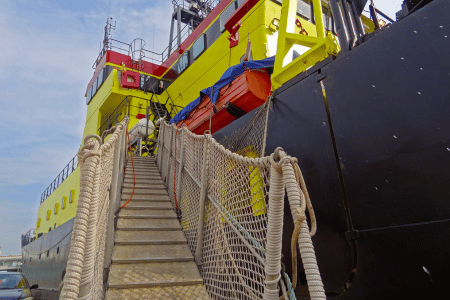
A tank cleaner fell when a gangway collapsed underneath him, injuring his knee, back, neck, wrist, and eyes. Lambert Zainey successfully resolved the case by showing that the gangway was not properly secured, per company procedures.
Which Laws Apply to Vessel Transfer Accident Claims
The law that governs your transfer accident claim depends on exactly where you were when the injury occurred and your job classification. This determination is critical — it affects what you can recover, who you can sue, and how long you have to act.
Injured While on a Vessel — Jones Act and General Maritime Law
If you were injured while on a vessel — on the deck of a supply boat or crew boat, or while being lifted in a basket departing from a vessel — and you qualify as a seaman, the Jones Act likely governs your claim against your employer. Under the Jones Act, an employer’s negligence need only play any part, even the slightest, in causing the injury — a significantly lower burden than standard negligence law. You are also entitled to maintenance and cure benefits — daily living expenses and medical coverage — regardless of fault.
If the accident was caused by another vessel’s negligence — a supply boat not properly positioned during the transfer, for example — you may have a general maritime law claim against the owner or operator of that vessel.
If unsafe conditions on the vessel contributed to the accident, you may also have an unseaworthiness claim against the vessel owner independent of any negligence claim.
Deadline: 3 years from the date of injury.
Injured on a Fixed Platform — OCSLA and the LHWCA
If you were injured after landing on a fixed offshore platform — or during a transfer in which the platform conditions contributed to the accident — OCSLA likely governs your claim. OCSLA extends LHWCA workers’ compensation benefits from your employer regardless of fault and allows separate negligence claims against the platform operator, contractors, and equipment manufacturers under Louisiana law.
⚠️Critical deadline: LHWCA/OCSLA workers must notify their employer within 30 days and file a formal claim within one year. Missing the 30-day notice permanently eliminates your right to LHWCA benefits.
When the Transfer Spans Both Vessel and Platform
Many transfer accidents happen in the transition — when a worker is between the vessel and the platform, in the basket or on the rope. These cases can involve overlapping legal frameworks and multiple defendants. An experienced maritime attorney will analyze the exact circumstances to identify the strongest available claims under each applicable framework and pursue all of them simultaneously.
Common Injuries in Vessel Transfer Accidents
Transfer accidents frequently involve falls from height, impacts with structures, or being struck by moving equipment. The injuries are often severe and permanent.
|
Injury Type |
Common Causes |
|
Traumatic brain injury |
Falls, basket impacts, swinging into structures |
|
Spinal cord injury and paralysis |
Falls from height, crushing, basket drops |
|
Multiple fractures |
Falls, impacts, being struck by equipment |
|
Crush injuries |
Caught between basket and platform, equipment failure |
|
Shoulder, knee, and back injuries |
Falls, sudden loads on joints during transfers |
|
Drowning and near-drowning |
Falls into water between vessel and platform |
|
Internal organ damage |
High-impact falls, crushing |
|
Lacerations and amputations |
Caught in rigging, contact with crane equipment |
Early settlement offers after transfer accidents almost never reflect the true long-term cost of these injuries. An experienced attorney will document the full lifetime impact before any settlement is considered.


Who Can Be Held Liable After a Transfer Accident
Multiple parties frequently share liability in transfer accident cases. Lambert Zainey investigates all of them simultaneously.
In most transfer accident cases maximum recovery requires pursuing every avenue of liability — not just the most obvious defendant.
Why Offshore Workers Trust Lambert Zainey With Transfer Accident Cases













Frequently Asked Questions About Vessel Transfer Accidents
Moving between vessels offshore can be risky, especially in rough conditions. This section answers key questions to help you understand your rights if you’re injured during a transfer.
Do I Have A Case? Quiz
Do you want to know if the details of your Maritime Accident HELP or HURT your case?
Take our short quiz to find out.
What to Do After a Vessel Transfer Accident
What Our Clients’ Say About Us
NATIONALLY RECOGNIZED ATTORNEYS






CONTACT US
Our experienced attorneys are here to guide you through every step of the process, from initial consultation to settlement or trial.
Free Case Review
Fill out the form below to contact Lambert Zainey and schedule a free, confidential consultation and discuss your case with an experienced attorney.