

Louisiana Jones Act Lawyers
Over $1 Billion Recovered for Maritime Accident Victims. We are proud to have a reputation for aggressively fighting for the rights of injured workers.
Jones Act Lawyers for Injured Seamen – Lambert Zainey Smith & Soso
If you were injured working on a vessel in the Gulf of Mexico or Louisiana waterways, the Jones Act gives you legal rights that most workers on land do not have. You can sue your employer directly for negligence. You can recover compensation for pain and suffering. And your employer must pay for your medical care and living expenses while you recover — regardless of fault.
But exercising these rights requires understanding which laws apply to your situation, meeting strict deadlines, and going up against employers and insurers who have legal teams working to minimize what you recover. Lambert Zainey has handled Jones Act claims for nearly 50 years. We understand the law, the industry, and what it takes to win these cases.
Injured Seaman? Find Out if You Have a Jones Act Claim.
On This Page
Quick Facts
What is the Jones Act? Your Rights as a Seaman
The Jones Act — formally the Merchant Marine Act of 1920, codified at 46 U.S.C. § 30104 — is a federal law that gives seamen the right to sue their employers for negligence when a workplace injury results from the employer’s failure to provide a reasonably safe working environment.
The Jones Act is fundamentally different from standard workers’ compensation in three ways.
2026 note: In March 2026 the Trump administration issued a temporary Jones Act waiver allowing foreign-flagged vessels to transport certain cargo between U.S. ports. This waiver affects commercial shipping logistics only — it has no effect on your legal rights as an injured seaman. Your right to file a Jones Act negligence claim, receive maintenance and cure, and pursue unseaworthiness claims remains fully intact.
Do You Qualify as a Jones Act Seaman?
Qualifying as a seaman is the threshold question in every Jones Act case.
The Two-Part Seaman Status Test
The U.S. Supreme Court established the controlling test for seaman status in Chandris, Inc. v. Latsis (1995). To qualify, a worker must satisfy both of the following:
Part 1 — Connection to the vessel’s mission
Your duties must contribute to the function of the vessel or the accomplishment of its mission. This requirement is broad — cooks, engineers, mechanics, welders, divers, and many other roles can satisfy this element if their work is part of how the vessel operates.
Part 2 — Substantial connection in duration and nature
You must have a connection to a specific vessel, or an identifiable fleet of vessels, that is substantial in both time and nature. Courts use a 30% guideline: if you spend at least 30% of your working time in service of a vessel in navigation, you likely qualify.
An important point for workers who are not formally assigned to one vessel: The Fifth Circuit recently reinforced that a worker does not need to be permanently assigned to a specific vessel to qualify as a Jones Act seaman. What matters is whether your work regularly exposes you to vessel-related risks and whether you have a meaningful connection to the vessel’s operations.
What Counts as a “Vessel”?
Under the Jones Act, a vessel is any watercraft that can be used to transport people or cargo on navigable water, or that is capable of doing so even if it is not being used that way at the moment. This covers:
It generally does not include fixed offshore platforms permanently attached to the seabed. Workers on those structures are typically covered by OCSLA instead.
Examples of Workers Who Often Qualify as Seamen
What Your Employer Must Provide — and What Happens When They Fail
Under the Jones Act, your employer has a legal duty to provide you with a reasonably safe place to work. When employers fail these duties, common negligence scenarios include:
One important note about post-accident drug and alcohol testing: A positive test result does not automatically bar your Jones Act claim — if the employer’s negligence or an unseaworthy condition contributed to the accident, you may still recover. Do not assume a positive test ends your case. Contact an attorney immediately before making any statements.
Proving Negligence Under the Jones Act
The Jones Act uses a significantly lower standard for proving negligence than ordinary personal injury law. Your employer’s negligence need only play “any part, even the slightest” in causing your injury. This is called the featherweight standard.
Comparative fault does not bar your claim. If you were partially at fault for the accident, your recovery is reduced by your percentage of fault — not eliminated.
If You Were Injured on a Vessel, You May Have Three Separate Legal Claims
Most injured seamen do not realize they can pursue more than one legal claim at the same time. Here is what each one covers and how they work together.
Jones Act Negligence
The direct lawsuit against your employer for their failure to maintain a safe workplace or the negligent acts of their crew. Allows recovery for all economic and non-economic damages including pain and suffering.
Deadline: 3 years from the date of injury.
Unseaworthiness
A separate claim against the vessel owner based on the vessel’s condition rather than the employer’s negligence. The vessel owner has an absolute duty to provide a vessel that is reasonably fit for its intended purpose. Learn about unseaworthiness claims →
Maintenance and Cure
A no-fault right available to all injured seamen regardless of who caused the accident. Your employer must pay daily living expenses and all reasonable and necessary medical treatment until you reach Maximum Medical Improvement.
Maintenance: Basic living expenses (like rent/mortgage, utilities, food) while you’re recovering ashore.
Cure: Reasonable and necessary medical treatment until you reach “Maximum Medical Improvement” (MMI) – meaning doctors don’t expect more treatment will make your condition better.
Learn more about your right to Maintenance and Cure ->
What Compensation Can You Recover?
|
Damage Category |
What It Covers |
|
Medical expenses |
All past and future treatment |
|
Lost wages |
Income lost during recovery |
|
Future earning capacity |
Wages you will be unable to earn due to permanent injury |
|
Pain and suffering |
Physical pain and emotional distress |
|
Mental anguish |
Depression, anxiety, PTSD from the accident |
|
Disfigurement |
Compensation for permanent scarring |
|
Loss of enjoyment of life |
Inability to participate in activities you previously enjoyed |
|
Vocational rehabilitation |
Retraining costs if you cannot return to maritime work |
Your Rights as a Seaman — A Summary
Over $1 Billion Recovered for Maritime Accident Victims
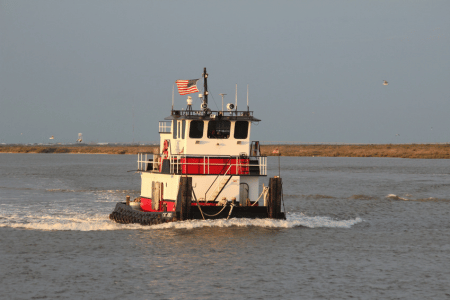
A deckhand on a push boat injured his back after being instructed to move a transfer hose by hand from one fuel barge to another.

An offshore mariner suffered serious neck and back injuries during a botched personnel basket transfer between two vessels.
What to Do After a Maritime Injury
Step 1: Seek medical attention immediately.
Your health is the first priority. Get emergency treatment if needed and follow up with a physician as soon as possible. Under maritime law you have the right to choose your own doctor for cure purposes. Do not let your employer direct you exclusively to company-appointed physicians.
Step 2: Report the injury in writing.
Report the accident to your employer, captain, or vessel officer as soon as possible and ensure a written incident report is filed. Do not rely on a verbal report alone. Keep a copy of anything you sign.
Step 3: Do not sign anything or give recorded statements.
Your employer’s insurer will move quickly after a maritime injury. Do not give a recorded statement, sign any medical authorization, or accept any offer before consulting a maritime attorney. See our 5 Costly Mistakes guide for the most common errors injured seamen make in the first 48 hours.
Step 4: Document everything.
Write down the details of the accident while your memory is fresh. Document the conditions, the equipment involved, any witnesses, and what was said afterward. Photograph your injuries and the accident scene if it is safe to do so. This documentation can be critical evidence.
Step 5: Contact Lambert Zainey.
Jones Act cases require attorneys who understand maritime law, who investigate immediately before evidence disappears, and who refuse to settle until every element of your damages has been fully documented. Contact us for a free, confidential consultation.













Frequently Asked Questions About Jones Act Claims
If you work at sea and get hurt, the Jones Act may help you get the care and support you need. This section answers common questions so you can better understand your rights and what steps to take next.
Do I Have A Case? Quiz
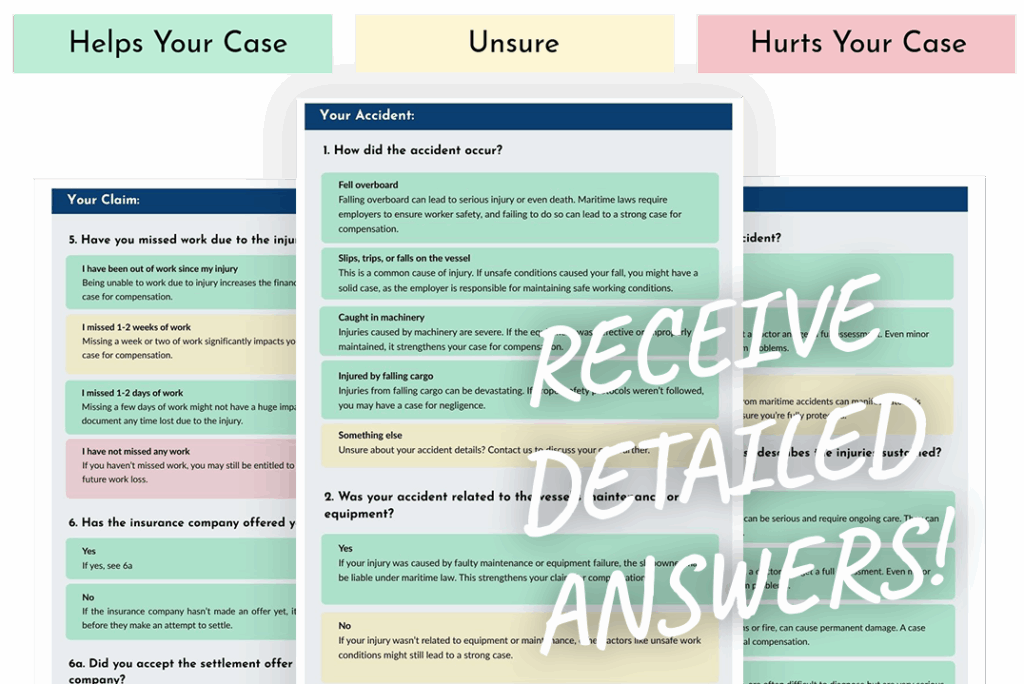
Do you want to know if the details of your Maritime Accident HELP or HURT your case?
Take our short quiz to find out.
What Our Clients’ Say About Us
NATIONALLY RECOGNIZED ATTORNEYS






CONTACT US
Our experienced attorneys are here to guide you through every step of the process, from initial consultation to settlement or trial.
Free Case Review
Fill out the form below to contact Lambert Zainey and schedule a free, confidential consultation and discuss your case with an experienced attorney.