
- The Jones Act statute of limitations is three years from the date of injury — or three years from the date you discovered or reasonably should have discovered your injury.
- A separate seven-day deadline requires you to report the injury to your employer. Missing this does not bar your claim but will be used against you by the company and their insurer.
- Exceptions to the three-year rule exist — including the discovery rule for occupational diseases and latent injuries — but they are narrow and difficult to establish. Do not rely on them.
- Waiting to file costs you more than time — evidence disappears, witnesses become unavailable, and vessel maintenance records get overwritten. The investigation must start immediately.
- If you are worried you have waited too long, call Lambert Zainey before concluding your case is over. The fastest way to know is a free consultation with an experienced Jones Act attorney.
The Jones Act gives injured seamen the right to sue their employers for negligence — but only if they act within a strict deadline. Missing that deadline permanently eliminates your right to compensation, regardless of how strong your case might have been.
Understanding the statute of limitations is one of the most important things you can do after a maritime injury. Here is everything you need to know.
The Three-Year Jones Act Filing Deadline
The Jones Act statute of limitations is three years from the date of injury — or three years from the date you discovered or reasonably should have discovered your injury.
Why waiting costs you — even inside the three-year window:
For a full breakdown of what to expect at each step of the Jones Act claims process, see our post on how long Jones Act lawsuits take.

The Seven-Day Reporting Requirement — A Separate Deadline
The three-year filing deadline and the seven-day reporting requirement are two completely different obligations with completely different consequences.
Under federal law, any work-related maritime injury must be reported to your employer within seven days of the accident.
Missing the seven-day deadline does not bar your Jones Act claim. But your employer will use the delay against you — arguing that your injury was not serious, did not happen at work, or occurred after you left the vessel. The longer you wait to report, the harder it becomes to counter those arguments.
Report your injury in writing as soon as possible — even a message to your supervisor creates a record. Do not wait to see how serious the injury turns out to be.
What If You Think You Have Missed the Three-Year Deadline?
Do not conclude your case is over before speaking with a maritime attorney. The three-year rule has nuances that can affect when the clock starts running.
The discovery rule
For occupational diseases and latent injuries — conditions that develop gradually rather than from a single accident — the three-year clock may start from the date you knew or reasonably should have known your condition was work-related. Hearing loss, repetitive stress injuries, and chemical exposure illnesses often fall into this category. If you were not immediately aware your symptoms were caused by your work on the vessel, the deadline may not have started when you assume it did.
Fraudulent concealment
If your employer deliberately concealed information that prevented you from knowing about your claim — misleading you about the cause of your injury or your legal rights — a court may toll the statute of limitations for the period of concealment. This is a difficult argument but it exists and has succeeded in documented cases.
What the deadline actually requires
Filing a Jones Act lawsuit within three years means filing in federal court — not just giving your employer notice, not just contacting a lawyer, not just submitting a workers’ compensation or LHWCA claim. If you have taken any of those steps but not formally filed suit, the clock is still running.
If you think you missed it: Even if your deadline appears to have passed, contact an attorney before concluding your case is barred. The analysis of when the clock started and whether any exception applies requires legal judgment — not a self-assessment. If the deadline has genuinely passed, an experienced attorney will tell you honestly. If it has not, the conversation may save your case.
Who Qualifies as a Jones Act Seaman?
To file a Jones Act claim, you must qualify as a seaman. The U.S. Supreme Court established the controlling test in Chandris, Inc. v. Latsis (1995): to qualify, you must spend at least 30% of your working time contributing to the function or mission of a vessel in navigation.
A vessel includes ships, tankers, tugboats, crew boats, supply boats, fishing vessels, drillships, and many other watercraft. It generally does not include fixed offshore platforms permanently attached to the seabed — workers on those structures are typically covered by OCSLA instead.
Workers who commonly qualify include captains and mates, deckhands, marine engineers, tankermen, cooks and stewards, commercial fishermen, and crew on crew boats and supply boats. Job title is not controlling — what matters is how you actually spend your working time and whether your duties contribute to the vessel’s operations.
If you are unsure whether you qualify, do not assume you do not. Seaman status is a legal determination that an experienced attorney should evaluate based on the specific facts of your employment.
Under the Jones Act, your employer must provide you with a reasonably safe place to work. When they fail and you are injured, you can pursue three separate legal claims simultaneously.
Common unsafe conditions that give rise to Jones Act claims:
Damages available in a Jones Act negligence claim include current and future medical expenses, lost wages and future earning capacity, pain and suffering, mental anguish, disfigurement, and loss of enjoyment of life.
Common unsafe conditions that give rise to Jones Act claims include cluttered or slippery decks, defective or broken equipment, improperly trained crewmembers, improperly secured cargo, lack of personal safety equipment, fire and electrical hazards, and poor lighting and ventilation.
What to Do Immediately After a Maritime Injury
Step 1: Report the injury in writing within seven days. This is your most time-sensitive obligation. Notify your supervisor immediately and ensure a written incident report is filed. Keep a copy.
Step 2: Get medical attention. You have the right to choose your own doctor. Seek treatment and tell every treating physician exactly how the injury occurred.
Step 3 — change to: Step 3: Do not sign anything. Complete only the required accident report — nothing else. Do not sign any document, give a recorded statement, or accept any offer before speaking with a Jones Act attorney.
Step 4: Contact Lambert Zainey. The three-year clock is already running. Contact us for a free, confidential consultation — and download our 5 Costly Mistakes guide to understand what to avoid in the critical first days after an accident.
Frequently Asked Questions About the Jones Act Statute of Limitations
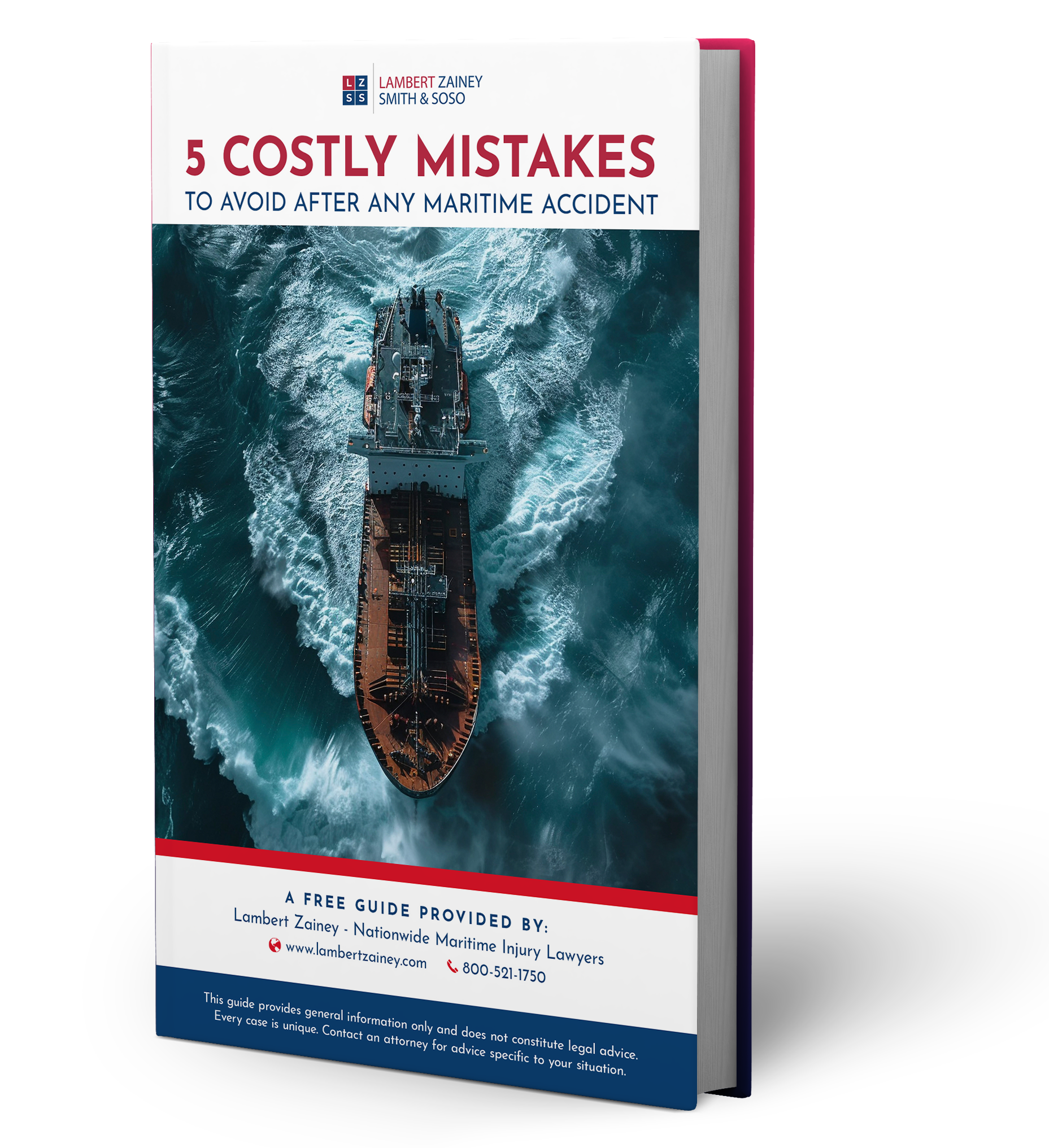
Get Our FREE Guide to Protect Your Claim
What you do after an accident is critical. Insurance companies will try to get you to make mistakes that can hurt your claim. Our free guide can help you avoid these traps.
Download our complimentary guide: “5 Costly Mistakes to Avoid After Any Maritime Accident” to arm yourself with the knowledge you need to protect your rights.
Contact Our Jones Act Attorneys
Lambert Zainey has represented injured seamen across the Gulf Coast for nearly 50 years. If you are worried about missing the Jones Act deadline — or if you have already been injured and are not sure where to stand — the fastest way to know is a free consultation.
Contact Lambert Zainey today for a free, confidential consultation.