

- A fast settlement is usually a bad settlement. Proper Jones Act lawsuits typically take several months to over a year to ensure you are fully compensated for future medical care.
- You have two strict deadlines: You must report your injury to your employer within 7 days, but you have 3 years to file a formal Jones Act lawsuit.
- You must reach MMI first. You cannot safely settle your case until a doctor declares you have reached Maximum Medical Improvement (MMI).
- Most cases settle out of court. Insurance companies generally prefer to negotiate a settlement rather than risk a massive jury verdict at trial.
- The clock is ticking on your evidence. While you have 3 years to sue, the evidence you need to win (CCTV footage, witness memories, logbooks) disappears in weeks.
If you were injured while working on a vessel, your bills are piling up. You are likely wondering how long it will take to resolve a Jones Act lawsuit and actually get paid.
The honest answer is: It depends. A straightforward claim might settle in a few months, while a complex case involving catastrophic injuries or multiple corporate defendants could take well over a year.
What you must understand is that the insurance company wants you to be impatient. They use your financial stress to push you into accepting a fast, lowball settlement before you know how much your future medical care will actually cost.
This guide breaks down exactly what to expect at every step of the Jones Act legal process, what factors will speed up or slow down your case, and the strict legal deadlines you absolutely cannot miss.
The Two Deadlines You Cannot Miss
Maritime law is unforgiving when it comes to deadlines. There are two separate clocks ticking the moment you are injured. Missing either one can destroy your case.
1. The Reporting Deadline: 7 Days
You only have seven days from the date of the accident (or the date you discovered your injury) to officially report it to your employer.
What happens if you miss it? You are not automatically barred from filing a lawsuit, but your employer will use the delay against you. They will argue the injury didn’t happen on the boat, or that it wasn’t serious. Report it immediately in writing, even if you think it is just a minor sprain.
2. The Statute of Limitations (Filing Deadline): 3 Years
Under federal maritime law, you have exactly three years from the date of your injury to file a formal Jones Act lawsuit in court.
- What happens if you miss it? Your right to compensation is permanently erased. There are no extensions and no grace periods. Once the three-year window closes, no attorney can help you recover a single dime, no matter how catastrophic your injuries are.
Why You Shouldn’t Wait 3 Years:
Even though you have three years to file, waiting is a massive mistake. Evidence disappears. Witnesses move to other companies. Vessel logbooks get “lost.” The sooner you hire a maritime attorney to issue a formal evidence preservation letter, the stronger your case will be.
Step-by-Step: The Jones Act Lawsuit Timeline
Every maritime accident is unique, but the federal litigation process follows a very predictable timeline. Here is a breakdown of what happens after you hire Lambert Zainey.
Phase 1: Investigation and Medical Stabilization
We do not rush to file a lawsuit on Day 1. First, we must thoroughly investigate the accident and wait for your medical condition to stabilize.
- Reaching MMI: This is the most critical delay. We cannot accurately calculate how much money to demand until your doctor declares you have reached Maximum Medical Improvement (MMI). If you need surgery, this phase takes time.
- Demanding M&C: During this time, we force your employer to pay your Maintenance and Cure benefits so you can survive financially while we build the larger lawsuit.
Phase 2: Filing the Lawsuit & Discovery
Once we know the full extent of your damages, we file the official complaint in federal or state court.
- The Defendant Responds: The maritime employer has 30 to 60 days to officially respond to our lawsuit.
- Discovery: This is usually the longest part of the process. Both sides exchange evidence, medical records, safety logs, and internal company emails.
- Depositions: Our attorneys will question the captain, crewmates, and company safety officers under oath. The company’s lawyers will also question you.
Phase 3: Expert Reports & Negotiation
Once the evidence is gathered, the case moves toward resolution.
- Expert Witnesses: We hire maritime safety experts, economists, and specialized doctors to testify exactly how the company was negligent and exactly how much money you will lose over your lifetime due to the injury.
- Mediation/Settlement: Before a trial begins, both sides usually meet with a neutral mediator. The vast majority of Jones Act cases settle right here. When the insurance company sees our mountain of evidence, they usually prefer to write a fair check rather than face a jury.
Phase 4: Trial
If the insurance company refuses to offer a fair settlement, Lambert Zainey will take them to court.
- Trials are rare, but they happen. A trial adds several months to the timeline, but juries frequently award significantly higher compensation than what was offered during settlement negotiations. We prepare every single case as if it is going to trial.
Has the Company Offered You a Quick Settlement?
If the insurance adjuster is waving a check in your face weeks after an accident, it is a trap.
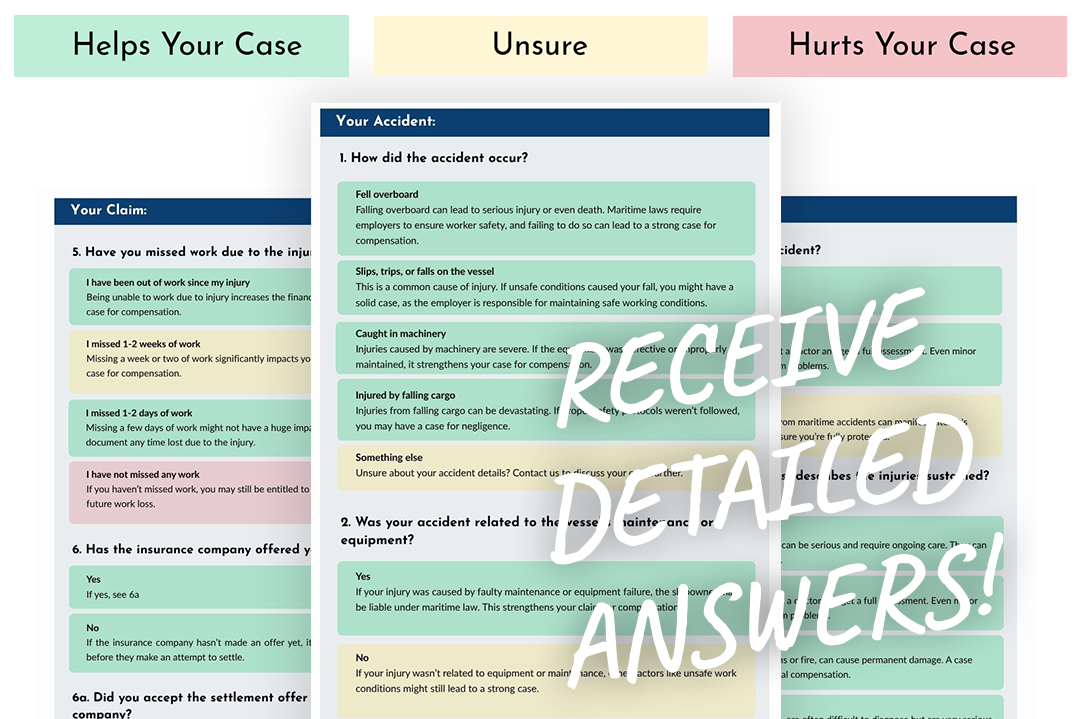
Take our free, 60-Second Maritime Case Quiz to find out what your case is actually worth.
5 Factors That Will Delay Your Settlement
If your case is taking longer than expected, it is usually due to one of these five factors:
Frequently Asked Questions About Jones Act Lawsuit Timelines
Speak to A Jones Act Attorney About Your Maritime Accident
The New Orleans Jones Act attorneys at Lambert Zainey Smith & Soso have over 40 years of experience handling maritime claims in Louisiana and all along the Gulf Coast. We’ve recovered over $1 billion for victims injured in a wide range of maritime accidents. If you’ve been injured on the job, let our team of maritime lawyers help you get the compensation you deserve.
You can contact our office through our website or call us at 800-521-1750 to schedule a free initial consultation with an experienced maritime attorney.