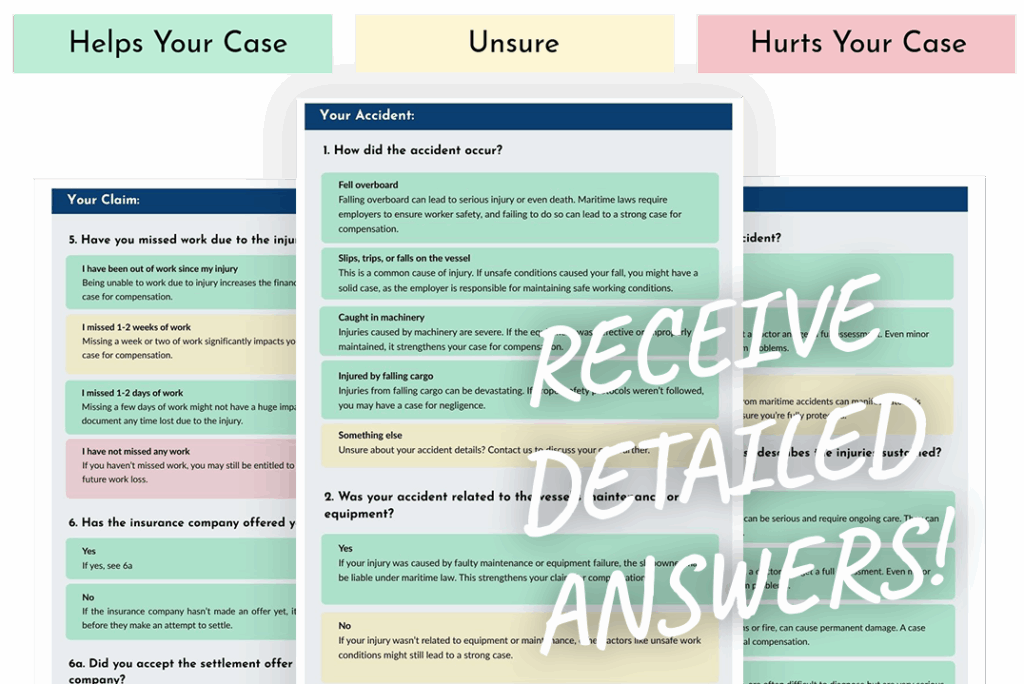

- Maintenance and cure benefits are a strict legal obligation. They must continue until a seaman reaches Maximum Medical Improvement (MMI)—the point at which further treatment will no longer improve their condition.
- MMI does not mean “healed.” A seaman can reach MMI while still suffering from pain or permanent disability. It only means your condition has stabilized.
- The company doctor’s MMI determination is not final. You have the absolute right to see your own physician. If your independent doctor disagrees with the company doctor, you have the right to fight the termination of your benefits.
- You can sue for premature termination. Employers who cut off benefits prematurely or in bad faith may be liable for the unpaid benefits, consequential damages, and even punitive damages.
- M&C is just the beginning. Maintenance and cure benefits are entirely separate from Jones Act negligence and Unseaworthiness claims, which are required to recover compensation for pain, suffering, and lost future wages.
When you get hurt on the job at sea, one of the first things you need to know is how long your employer has to keep paying your medical bills and living expenses. The answer hinges on a medical and legal concept called Maximum Medical Improvement (MMI).
Knowing what MMI truly means—and spotting when your employer or the company doctor is using it against you—is critical to protecting your physical recovery and your financial future.
The short answer is: Your benefits must continue until a qualified doctor states your condition cannot improve any further with medical treatment.
In reality, employers frequently dispute, rush, or artificially declare MMI to save money. Knowing how to fight back when that happens is the difference between a full recovery and financial ruin.

What Are Maintenance and Cure Benefits?
Under general maritime law, every seaman injured in the service of a vessel is entitled to Maintenance and Cure, regardless of who was at fault for the accident.
Important Note: Maintenance and Cure is a “no-fault” benefit. However, it is separate from any other legal claim you may have. Receiving these benefits does not stop you from filing a high-value Jones Act negligence claim against your employer or an unseaworthiness claim against the vessel owner to recover your lost future wages and pain and suffering.
Maximum Medical Improvement (MMI) and the End of Benefits
Maximum Medical Improvement (MMI) is the specific point at which a physician determines that your injury has stabilized and that further medical treatment will not improve your condition.
Once you reach true MMI, your employer’s obligation to pay Maintenance and Cure ends.
Because MMI is the trigger that stops the company from paying, it is often heavily manipulated. Here is what every injured seaman must understand about MMI:
MMI is NOT the same as being “fully healed.”
A seaman can reach MMI and still be in chronic pain, have severely limited movement, or be permanently disabled. MMI simply means that more treatment (like surgery or physical therapy) is unlikely to make you any better. It does not mean you are “back to normal.” Employers often blur this line, claiming you are “healed” just to cut off your benefits.
MMI is NOT the same as being “fit for duty.”
If your employer says you have reached MMI, it does not mean you are cleared to go back to heavy maritime labor. A seaman can reach MMI and be physically unable to ever do their previous job again.
WHO determines MMI matters.
The doctor who decides whether you have reached MMI controls when your benefits stop. If the only doctor evaluating you was chosen and paid by your employer (the “company doctor”), their opinion is inherently biased and may not reflect your true medical needs.
MMI can (and should) be disputed.
If your independent treating physician and the company’s doctor disagree about whether you have reached MMI, your benefits should not automatically end. Under maritime law, your independent doctor’s opinion carries significant legal weight. You have the absolute right to fight the company’s position in court.
|
What MMI Means |
What MMI Does NOT Mean |
|---|---|
|
Your condition has stabilized and more treatment won’t improve it |
You are fully healed or pain-free |
|
Your employer’s maintenance and cure obligation ends |
You are cleared to go back to work |
|
A doctor has made a medical judgment about your recovery |
Your employer gets to arbitrarily decide when your benefits stop. |
|
Your daily living stipend and medical coverage stop. |
Your right to file a Jones Act or unseaworthiness claim ends |
What Happens if Your Injury Is Permanent?
Permanent injuries create one of the harshest realities in maritime law. If you suffered a catastrophic injury—such as spinal cord damage, a traumatic brain injury (TBI), or an amputation—your doctor may declare you have reached MMI fairly quickly, because medicine can only do so much to fix the damage.
This means your employer’s Maintenance and Cure obligation can technically end within months of your injury, even though you require lifelong care and can never work at sea again.
If your injury is permanent, you must understand two critical facts:
Get Our FREE Guide to Protect Your Claim
What you do after an accident is critical. Insurance companies will try to get you to make mistakes that can hurt your claim. Our free guide can help you avoid these traps.
Download our complimentary guide: “5 Costly Mistakes to Avoid After Any Maritime Accident” to arm yourself with the knowledge you need to protect your rights.
The “Company Doctor” Trap: When You’re Told You’re Done (But You Aren’t)
The most common tactic employers use to cut off Maintenance and Cure prematurely is sending you to a “company doctor” who is incentivized to declare you at MMI before you are actually ready.
How the trap works: After your injury, your employer requires you to see their clinic. That doctor—who relies on the employer or their insurer for business—examines you quickly and declares you have reached MMI. Your employer instantly uses that report to stop your checks and refuse to pay for further medical coverage, even if you are still in agony and your own doctor strongly disagrees.
How maritime law protects you:
If your employer has cut off your benefits based on a biased company doctor’s MMI call, that decision is not final. You need a maritime attorney to step in immediately.
What Can You Do if Your Employer Cuts Off Maintenance and Cure Prematurely?
If your employer terminates your Maintenance and Cure benefits before you have genuinely reached Maximum Medical Improvement, you have powerful legal options.
- Continue treatment and document everything. Keep going to your own independent doctor. Follow their treatment plan. Save every appointment record, every MRI or diagnostic test, and every written recommendation. This paper trail is the foundation of your fight.
- Demand an independent medical evaluation. If you have only seen the company doctor, find a specialist with no connection to the maritime industry and get their opinion in writing. A second opinion that contradicts the company’s MMI finding is the strongest weapon in a legal dispute.
- Consult a maritime attorney immediately. An employer who cuts off your benefits without a legitimate medical reason opens themselves up to serious legal consequences. You can sue to have your benefits reinstated, and if the court finds the employer acted callously or in bad faith, they can be forced to pay your attorney’s fees and punitive damages.
For a deeper dive into your legal options when checks stop, read our guide: What to Do If Your Employer Ends Maintenance and Cure Too Soon).
What to Do Next – Protect Your Right to Recovery
If your Maintenance and Cure benefits have been cut off and you do not believe you have truly reached MMI, do not wait.
The evidence that matters most—medical records, the biased company doctor’s report, your own doctor’s findings, and the financial harm you are suffering—must be secured immediately after your checks stop.
The maritime trial attorneys at Lambert Zainey have been fighting for injured seamen’s Maintenance and Cure rights for more than 40 years. We know exactly how employers manipulate MMI to cut benefits short, and we have the power to push back.
If your benefits have been reduced, denied, or stopped prematurely, contact our nationally recognized team for a free, confidential consultation. We never charge a fee unless we win your case.