

If you’re a maritime worker who has been injured on the job, one of the most confusing — and most important — questions is: which law protects me?
The rules for a crew member on a boat are completely different from the rules for a worker on a dock or a fixed platform. Getting it wrong can seriously impact your ability to get fair compensation.
The two main laws you’ll hear about are the Jones Act and the Longshore and Harbor Workers’ Compensation Act (LHWCA). They are not the same, and knowing the difference is critical.
Watch: Our 60-Second Video Explainer
Watch our quick video below for a straightforward explanation of the key differences between the Jones Act and the LHWCA.
Key Takeaways — Jones Act vs. LHWCA
For a quick summary, here are the most important points from the video:
- It all depends on WHERE you work: The main difference between the two laws comes down to your connection to a vessel.
- The Jones Act is for SEAMEN: If you are a crew member on a moving vessel (like a tugboat, supply boat, or movable rig), you are likely a “seaman” protected by the Jones Act.
- LHWCA is for HARBOR WORKERS: If you work at a fixed location like a dock, shipyard, or fixed platform, you are likely a “harbor worker” covered by the LHWCA.
- Jones Act allows lawsuits for PAIN & SUFFERING: This is a critical difference. The Jones Act law allows you to sue your employer for negligence and recover money for your pain and suffering.
- LHWCA is a “no-fault” system: It provides benefits for medical bills and lost wages, similar to workers’ comp, but generally does not include compensation for pain and suffering.
Video Transcript
(Voiceover): “If you’re injured in a maritime accident, the law that protects you all comes down to one big question: Where did you work?
If you are a seaman — part of the crew on a vessel in navigation like a tugboat, supply boat or movable rig — you are likely protected by the Jones Act. This powerful law allows you to sue your employer for negligence — or carelessness — and recover money for your medical bills, lost wages, and your pain and suffering.
But if you’re a harbor worker, like a longshoreman or a shipbuilder, you are likely covered by the Longshore and Harbor Workers’ Compensation Act, or LHWCA. This is a federal workers’ compensation system. It provides benefits for medical treatment and lost wages, usually without needing to prove it was your employer’s fault.
The key difference is your connection to a vessel. Getting this right is critical for your case, and figuring it out is our job.
If you’ve been injured on the water or at a port, contact the experienced maritime lawyers at Lambert Zainey for a free, confidential consultation. We’ll help you understand your rights.”
Jones Act vs. LHWCA: Key Differences at a Glance
|
Factor |
Jones Act |
LHWCA |
|---|---|---|
|
Who’s Covered |
Seamen on vessels in navigation |
Harbor workers on docks, shipyards, fixed platforms |
|
Worker Examples |
Tugboat crew, supply boat deckhands, offshore rig crews on movable vessels |
Longshoremen, stevedores, shipbuilders, ship repairers, cargo handlers |
|
Must Prove Fault? |
Yes – must prove employer negligence |
No – “no-fault” system |
|
Pain & Suffering |
||
|
Lost Wages |
||
|
Medical Coverage |
||
|
Where to File |
Federal court lawsuit |
Administrative proceedings (DOL) |
|
Deadline to Notify |
7 days to report injury to employer |
|
|
Deadline to File Claim |
3 years |
|
|
Can Sue Employer |
Understanding the Jones Act
What Is the Jones Act?
The Jones Act (Merchant Marine Act of 1920) is a federal maritime law that protects workers who are injured while serving as crew members on vessels operating on navigable waters.
Who Qualifies as a “Seaman”?
To be covered under the Jones Act, you must qualify as a “seaman”:
- Spend at least 30% of your work time on a vessel or fleet of vessels
- The vessel(s) must be in navigation (not permanently fixed)
- You must have a substantial connection to the vessel
Examples of Jones Act Seamen:
- Tugboat captains and crew
- Supply boat deckhands
- Crewmen on movable offshore drilling rigs
- Ship’s mates and engineers
- Tankermen on barges
- Commercial fishing vessel crew
- River barge and towboat workers
Compensation Available Under the Jones Act
If you are a seaman injured at work, you are entitled to:
1. Maintenance and Cure (No-Fault Benefits)
Every seaman receives these benefits regardless of fault:
- “Maintenance” = Daily living expenses while unable to work
- “Cure” = All reasonable medical treatment
- Continues until you reach maximum medical improvement
2. Jones Act Negligence Claim
If your injury was caused by your employer’s negligence (even partially), you can recover:
Economic Damages:
- Lost wages (100% of past and future wages)
- Loss of future earning capacity
- Future medical expenses
- Rehabilitation costs
Non-Economic Damages:
- Pain and suffering
- Mental anguish and emotional distress
- Loss of enjoyment of life
- Disfigurement and scarring
Proving Negligence: You only need to prove employer negligence played even the slightest role in causing your injury. Examples include:
- Failure to provide adequate safety equipment
- Improper training
- Unsafe vessel conditions
- Inadequate crew staffing
- Violation of safety standards
Understanding the LHWCA
What Is the LHWCA?
The Longshore and Harbor Workers’ Compensation Act (LHWCA), enacted in 1927, provides benefits for maritime workers who work on navigable waters or adjacent areas but are not seamen.
Who Is Covered by the LHWCA?
The LHWCA covers workers employed in support of the maritime industry:
Common LHWCA-Covered Workers:
- Longshoremen
- Stevedores
- Harbor workers
- Shipbuilders and ship repairers
- Cargo handlers
- Marine terminal workers
- Workers on fixed offshore platforms (via OCSLA extension)
Compensation Available Under the LHWCA
Medical Benefits
- Full coverage for all reasonable and necessary medical treatment
- No dollar limits
- Continues for life if needed
Disability Benefits (Wage Replacement)
- Two-thirds (66.67%) of your average weekly wage
- Temporary or permanent disability payments
- Subject to annual maximum limits
- Benefits are administered by the U.S. Department of Labor’s Office of Workers’ Compensation Programs.
Vocational Rehabilitation
- Job training and retraining programs
- Job placement assistance
- Maintenance payments during retraining
Death Benefits
- Burial expenses up to $3,000
- Survivor benefits (50% of wages to spouse, additional for children)
What the LHWCA Does NOT Cover
However: You CAN sue third parties (vessel owners, contractors, equipment manufacturers) whose negligence contributed to your injury. These third-party claims can provide pain and suffering damages.
Frequently Asked Questions
Get Our FREE Guide to Protect Your Claim
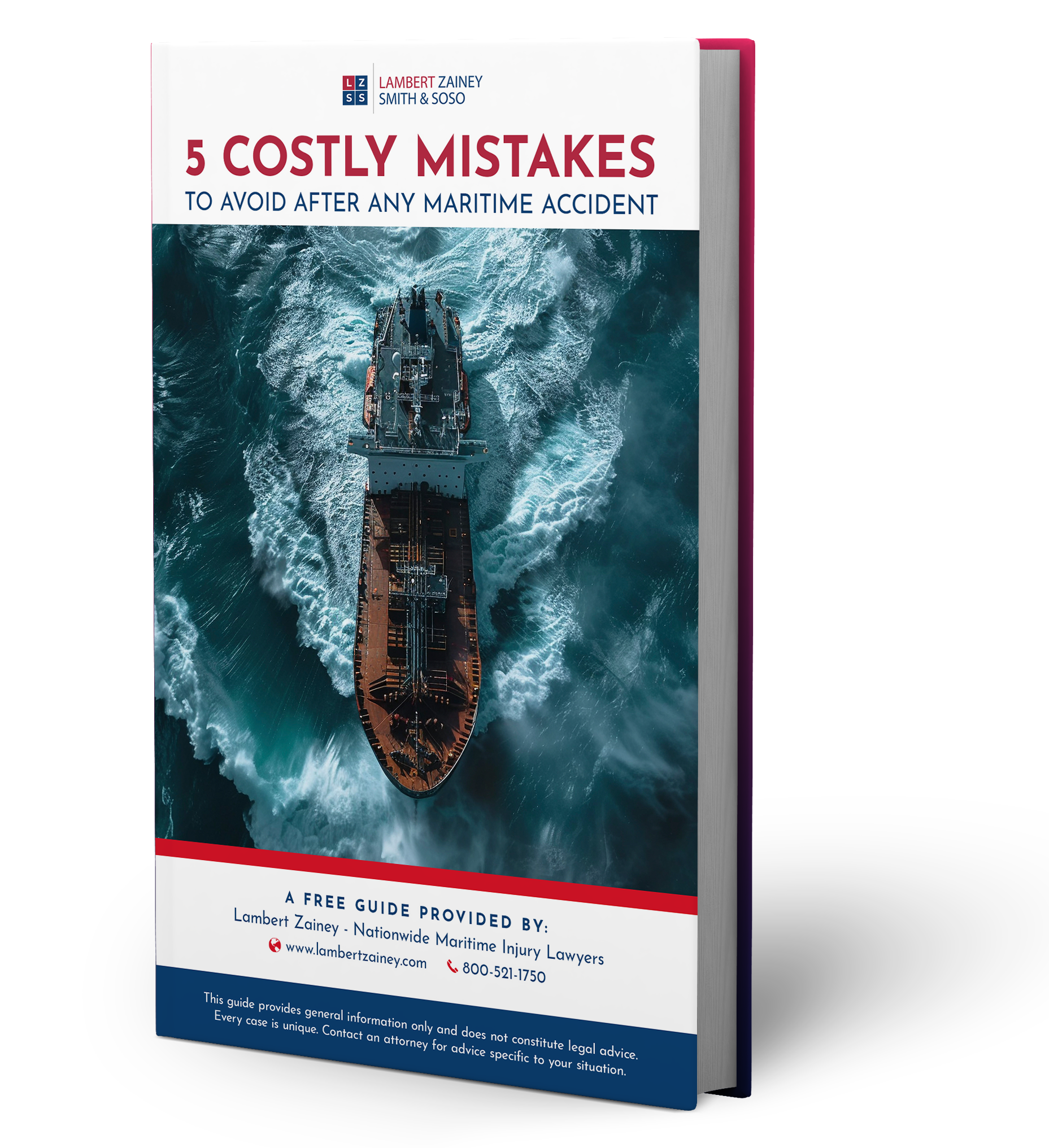
No matter which law applies to you, what you do after an accident is critical. Our free guide helps you avoid common mistakes that could hurt your ability to get fair compensation.
Download our complimentary guide: “5 Costly Mistakes to Avoid After Any Maritime Accident” to learn how to protect yourself and your family.
Still Have Questions? Talk to a New Orleans Maritime Lawyer for Free.
Figuring out your legal status and your rights after a maritime injury can be confusing and stressful. You don’t have to do it alone.
The attorneys at Lambert Zainey have decades of experience with both Jones Act and LHWCA claims. We’ve recovered more than $1 billion for injured maritime workers and their families.
Call Us 24/7: 800-521-1750 📞
Related Resources: