
- LHWCA benefits cover medical expenses and two-thirds of your lost wages, but they do not cover pain and suffering, full lost wages, or long-term disability costs. In serious injury cases, LHWCA benefits alone are often not enough.
- Even though LHWCA generally prevents you from suing your own employer, it does not prevent you from suing a third party. A third-party can be a vessel owner, equipment manufacturer, contractor, or property owner whose negligence contributed to your accident.
- A third-party lawsuit can provide compensation for pain and suffering, full lost wages, and long-term disability costs on top of whatever LHWCA benefits you receive.
- Do not assume your only option is LHWCA benefits. The most important thing you can do after a serious dock injury is speak with an attorney who investigates third-party liability as a matter of course.
- The 1989 ARCO platform explosion is one of Lambert Zainey’s most significant third-party dockworker and maritime cases. The firm secured major settlements for workers injured or killed when an improperly performed pipeline cut caused a catastrophic explosion, demonstrating exactly what third-party liability can recover beyond LHWCA benefits.
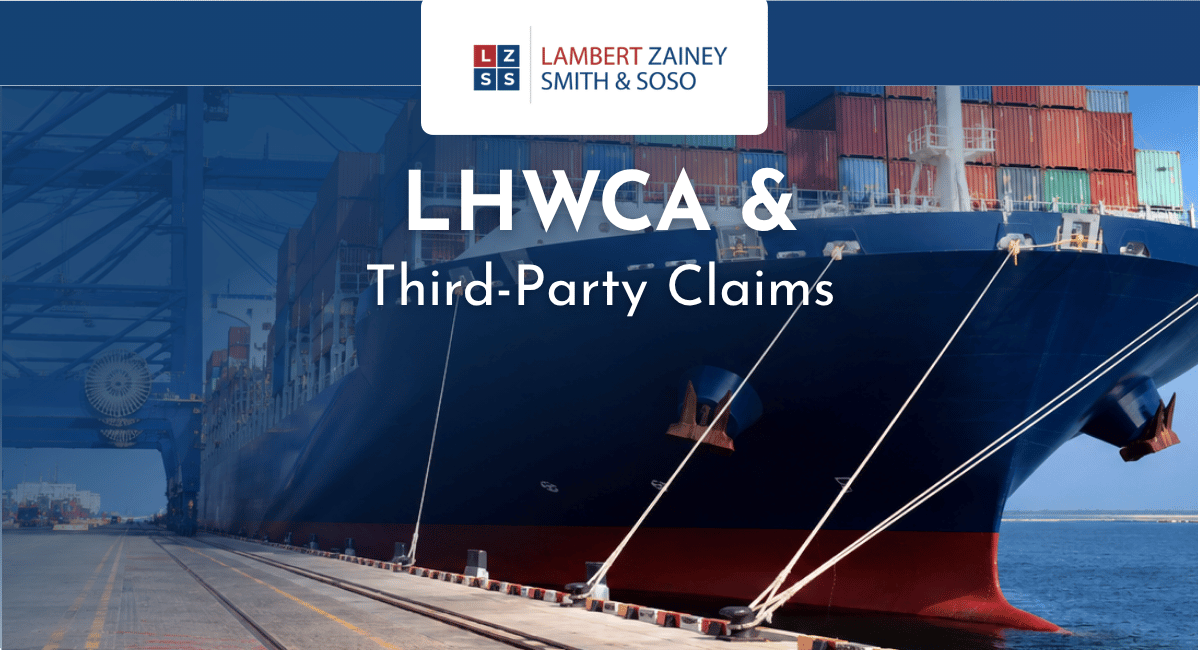
When a dockworker is injured on the job in Louisiana, the Longshore and Harbor Workers’ Compensation Act (LHWCA) provides medical benefits and partial wage replacement regardless of fault. But there is a significant trade-off: by accepting LHWCA benefits, you generally give up the right to sue your own employer.
What many dockworkers do not know is that LHWCA does not prevent you from suing everyone else. If a vessel owner, a crane manufacturer, a chemical company, or another contractor contributed to your accident, you can pursue a separate third-party lawsuit against them — while still receiving your LHWCA benefits. That third-party lawsuit can include compensation for pain and suffering that LHWCA benefits never provide.
Lambert Zainey investigates third-party liability in every dockworker injury case. Here is how it works.
LHWCA Benefits Often Don’t Cover the Full Costs of Your Injuries
The problem is, in cases of really serious injury, LHWCA benefits don’t come close to providing the total amount of compensation needed to fully cover the losses and ongoing expenses caused by their injuries. However, there are other options available to injured dockworkers who need to recover additional compensation for the damages caused by their injuries. One of these options is filing a third party claim for dockworker injuries.
What is a Third Party Claim?
A third party claim, or third party lawsuit, seeks compensation from a third party — a person or company who is not your employer — who shared liability for the accident that caused the dockworkers’ injuries.
Even though you can’t take legal action against your employer, an attorney will be able to investigate the causes of your accident and determine who was responsible. It’s not uncommon for a third party to be responsible for your injuries.
Examples of Third Parties Who May Share Liability in a Dockside Accident
Examples in which a third party could be held responsible for an accident includes:
Vessel owner negligence. When a dockworker is injured while working on or alongside a vessel, the vessel owner may be independently liable. This is true even if the dockworker’s direct employer is the stevedoring company, not the vessel owner. Under the Scindia doctrine, established by the U.S. Supreme Court in Scindia Steam Navigation Co. v. De Los Santos (1981), vessel owners owe dockworkers three specific duties:
A dangerous deck condition, an unsecured hatch cover, defective rigging equipment, or a poorly maintained gangway can all support a lawsuit against the vessel owner under the Scindia doctrine. This claim stands on its own, separate from your LHWCA benefits and separate from any claim against your employer.
Equipment manufacturer liability: Cranes, forklifts, rigging equipment, and cargo handling machinery that malfunctions due to a design defect or manufacturing error can support a product liability claim against the manufacturer. Product liability claims do not require proving negligence, only that the equipment was defective and caused the harm. If a crane boom collapse or forklift failure caused your injury, the manufacturer may be liable regardless of how the equipment was maintained.

Chemical and materials manufacturer liability: Dockworkers who develop lung disease, cancer, or other conditions from exposure to asbestos, toxic fumes, or hazardous cargo can pursue product liability claims against the manufacturers of those substances. These claims follow the discovery rule. The limitations clock begins from when you knew or should have known your illness was work-related, not from the date of original exposure.
Another individual: If your injuries resulted from an attack by a co-worker you can file a third party lawsuit against the individual.
Winning a Third Party Claim for Dockside Injuries
As with any other lawsuit, in order to prevail in a third-party lawsuit, you’ll have to prove that:
The most challenging element in most dockworker third-party cases is proving that the third party, not just your employer, was responsible for the accident. Vessel owners and equipment manufacturers are represented by experienced legal teams who move quickly to limit their exposure. Evidence like maintenance records, cargo manifests, crane inspection logs, and surveillance video disappears fast.
Lambert Zainey files evidence preservation demands in dockworker injury cases immediately, before records are lost or overwritten.
What to Do After a Dockworker Injury
Step 1: Get medical treatment and file your LHWCA claim.
Report your injury to your employer within 30 days and file Form LS-203 with the Department of Labor within one year. Your LHWCA benefits provide immediate medical coverage while your third-party case is investigated.
Step 2: Do not sign anything from the vessel owner or their insurer.
Third parties — vessel owners, equipment manufacturers, contractors — begin protecting themselves from liability immediately after a dock accident. Do not sign any document, give a recorded statement, or accept any offer from a third party before speaking with an attorney.
Step 3: Contact Lambert Zainey immediately.
Third-party dockworker cases require immediate evidence preservation and investigation. Contact us for a free, confidential consultation.
If you work on a fixed offshore platform: Your claim may be governed by OCSLA rather than LHWCA. The same third-party claim principles apply, but the procedural rules differ. Contact Lambert Zainey to evaluate which law covers your situation.
Frequently Asked Questions
Injured on a Louisiana Dock or in a Shipyard? Here Is What to Do Next.
LHWCA benefits are just the beginning. Lambert Zainey investigates every dockworker injury case for third-party claims against vessel owners, equipment manufacturers, and contractors that can recover pain and suffering, full lost wages, and long-term disability costs that LHWCA benefits never provide.
- Nearly 50 years representing injured longshoremen, dockworkers, and shipyard workers across Louisiana’s Gulf Coast ports
- Active pursuit of third-party claims — we always investigate whether a vessel owner, contractor, or equipment manufacturer bears independent liability
- Over $1 billion recovered for injured maritime workers and their families
- No fees unless we recover for you
Contact Lambert Zainey today for a free, confidential consultation. There are no fees unless we recover for you. Call us at 800-521-1750.