

OSHA Fatal Four: How These Top 4 Hazards Prove Maritime Negligence

If You’ve Been Hurt, This Is Why — And It Wasn’t Your Fault

If you’ve been seriously injured in a fall from a scaffold, crushed by machinery, struck by falling cargo, or shocked by faulty electrical equipment, you need to understand something critical: Your accident was almost certainly preventable.

The Occupational Safety and Health Administration (OSHA) calls these the “Fatal Four” — the four hazards responsible for nearly 60% of construction worker deaths nationwide:

  • Falls
  • Caught-in/Between
  • Struck-by Object
  • Electrocution

In maritime work — shipyards, docks, offshore platforms and vessels — these same four hazards cause the majority of catastrophic injuries and deaths. When you’re hurt in one of these accidents, it’s almost always because your employer violated basic federal safety laws.
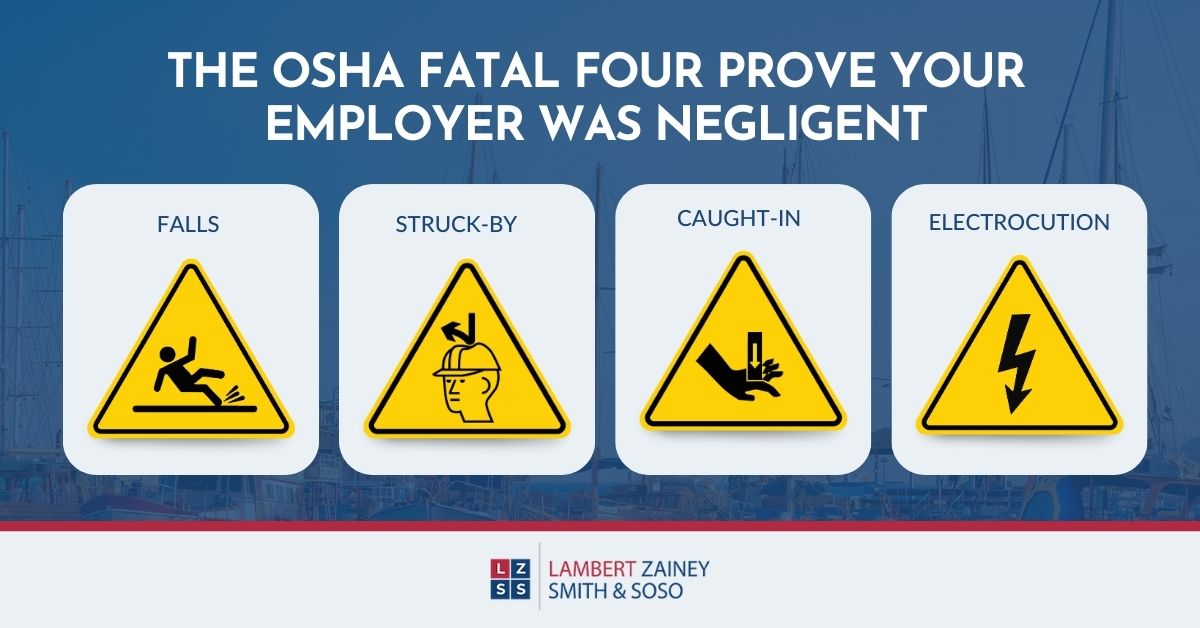
OSHA Fatal Four

This guide explains how these violations prove your employer was negligent, what evidence protects your claim, and what you need to do right now to protect your rights.

At Lambert Zainey, we’ve spent decades fighting for injured maritime workers. We know how to use OSHA violations to prove your case under the Jones Act, LHWCA, or General Maritime Law — and we know how to force large corporations to pay for the harm they’ve caused.

Why Your Fatal Four Accident Proves Negligence

OSHA regulations aren’t suggestions — they’re the minimum legal standard for workplace safety. When your employer violates these standards and you get hurt, that violation is powerful proof they failed to protect you.

OSHA Fatal Four: By the Numbers

Hazard

% of Deaths

Falls

36-38%

Scaffolding, ladders, deck openings, overboard

29 CFR 1915.159

Struck-by

10-12%

Falling cargo, crane loads, mooring lines

29 CFR 1917.112

Caught-in/Between

5-7%

Vessel-to-dock crushing, unguarded machinery

29 CFR 1915.89

Electrocution

8-10%

Shore power, damaged tools, wet environments

29 CFR 1915.131-137

Combined

~60%

Majority of serious maritime injuries

Parts 1915-1918

Source: OSHA National Census of Fatal Occupational Injuries

How This Works in Your Case:

If You’re a Jones Act Seaman:
Your employer’s violation of industry safety standards — whether OSHA, Coast Guard, or accepted maritime practices — is strong evidence they were negligent. We use these violations to prove your employer failed to provide a reasonably safe workplace.

If You’re an LHWCA-Covered Worker (Longshore/Dockworker):
OSHA’s maritime standards (29 CFR Parts 1915-1918) directly govern your workplace. A violation that caused your injury is clear proof the employer breached their duty of care, supporting third-party claims against vessel owners and contractors.

If You’re Claiming Unseaworthiness:
When a dangerous condition exists because of an OSHA violation — like an unguarded machine or missing fall protection — it proves the vessel wasn’t reasonably fit for its purpose. This supports a strict liability unseaworthiness claim.

The Bottom Line: If you were hurt in a Fatal Four accident, the negligence isn’t hidden. The violation of federal safety law proves it.

The Fatal Four: What Happened to You and Why It Was Illegal

1. Falls (The #1 Killer in Maritime Work)

What Happened:
You fell from scaffolding, a ladder, through a deck opening, from a platform, or overboard — and you weren’t protected by guardrails, safety nets, or a working fall arrest system.

Why It Was Illegal:
Under OSHA’s shipyard standards (29 CFR 1915.159), your employer was required to provide fall protection at heights of 5 feet or more — or at ANY height if you were working over hazardous substances or dangerous objects. They failed.

Common Violations We See:

  • No guardrails on temporary work platforms or scaffolding
  • Broken or missing personal fall arrest equipment (harness, lanyard)
  • Uncovered deck openings and hatches
  • Ladders without proper securing or tie-off points
  • Zero fall protection training

When Fall Protection Is Required in Maritime Work

Work Type

Shipyard scaffolds

5 feet or more

Guardrails or personal fall arrest

Over hazardous substances

ANY height

Guardrails, nets or harness system

Marine terminal surfaces

4 feet or more

Guardrails or hole covers

Vessel deck work

5 feet or more

Guardrails meeting OSHA height specs

What This Proves: Your fall wasn’t an accident. It was the predictable result of your employer’s decision not to follow basic safety laws.

2. Struck-by Object (Cargo, Tools, Equipment)

What Happened:
You were hit by falling cargo, struck when rigging failed, injured by a snapping mooring line, or hit by moving equipment or vehicles on the dock.

Why It Was Illegal:
OSHA’s marine terminal (29 CFR 1917) and longshoring standards (29 CFR 1918) require employers to inspect rigging equipment, establish exclusion zones under suspended loads, secure tools at heights, and use trained signal persons for crane operations. They didn’t.

Common Violations We See:

  • Rigging equipment not inspected within the required 12-month period
  • No exclusion zone enforced under crane loads
  • Cargo not properly secured during loading/unloading
  • Untrained or uncertified crane operators
  • Tools and materials not secured when working at heights

What This Proves: Your employer knew objects could fall or strike workers — federal law requires specific protections. They chose not to provide them.

3. Caught-in/Between (Crushing and Amputation)

What Happened:
You were crushed between a vessel and the dock, your hand or limb was caught in an unguarded winch or machinery, or you were pulled into equipment during maintenance.

Why It Was Illegal:
OSHA’s lockout/tagout standards (29 CFR 1915.89) and machine guarding requirements (29 CFR 1915.82) require employers to shut down and lock out machinery during maintenance, install guards on all moving parts, and provide adequate clearance during vessel operations. They didn’t comply.

Common Violations We See:

  • No lockout/tagout procedures implemented or enforced
  • Unguarded winches, gears, chains and rotating equipment
  • Inadequate communication during vessel-to-dock approach
  • Workers allowed near pinch points without proper procedures
  • No machine-specific safety training

What This Proves: Crushing and amputation injuries are 100% preventable. Your employer’s failure to follow basic machine safety laws caused your life-changing injury.

4. Electrocution (Shocks and Burns)

What Happened:
You contacted damaged electrical cables, were shocked by faulty shore power connections, touched energized equipment in a wet environment, or were injured by improperly grounded machinery.

Why It Was Illegal:
OSHA’s electrical safety standards for maritime work (29 CFR 1915.131-137) require ground fault circuit interrupters (GFCIs) in wet locations, proper grounding of all equipment, regular inspection of electrical cords and tools, and use of qualified electricians for repairs. Your employer violated these requirements.

Common Violations We See:

  • No GFCIs installed despite constant water exposure
  • Damaged electrical cords and tools still in use
  • Electrical equipment not properly grounded
  • Unqualified workers performing electrical work
  • No electrical safety training provided

What This Proves: Electricity and water are a deadly combination. Your employer knew this — federal law requires specific precautions in maritime environments. They failed to provide them.

What You Must Do Right Now to Protect Your Claim

If you’ve been hurt in a Fatal Four accident, employers move fast to cover up evidence. Here’s what you need to do immediately:

Within 24 Hours:

1. Get Medical Treatment
Even if you think you’re “okay,” get checked. Falls can cause internal injuries, electrical contact can damage your heart, and crushing injuries may have delayed complications. Your medical records are critical evidence.

2. Report Your Injury in Writing
Tell your supervisor or employer about the accident in writing — email, text, or written form. Under LHWCA, you have 30 days to give written notice, but do it immediately. Get a copy of any accident report they create.

3. Document Everything You Can
If physically able, take photos of:

  • Where the accident happened
  • Any safety equipment that was missing or broken
  • The hazard that caused your injury (missing guardrail, exposed wiring, unguarded machine)
  • The lack of warning signs or barriers

Get contact information from anyone who saw what happened — before the company separates you from your coworkers.

4. Preserve Any Physical Evidence
Keep damaged equipment: torn safety harness, broken tools, damaged electrical equipment, torn clothing showing machinery contact. Don’t let your employer take this evidence “for investigation” without photographing it first.

Within 72 Hours:

5. Contact a Maritime Lawyer Immediately
Fatal Four cases require fast action because:

  • Employers quickly repair hazards and destroy evidence
  • Coworkers may be pressured to change their stories
  • You have strict deadlines (30 days for LHWCA notice, 3 years for Jones Act)
  • The company’s lawyers are already working to minimize your claim

An experienced maritime attorney will immediately demand that your employer preserve all evidence before it “disappears.”

The Evidence Your Lawyer Will Demand

When you hire Lambert Zainey, we immediately force your employer to turn over the documents that prove their negligence:

OSHA Inspection Reports: Showing your employer was cited for the same violations before your accident — proving they knew about the danger.

Internal Accident Investigation Files: Often these reports admit safety rules were violated.

Safety Meeting Minutes: Documenting that supervisors and managers knew about the specific hazard (like “broken guardrail on deck 3”) but failed to fix it.

Maintenance and Inspection Records: Proving equipment wasn’t maintained or inspected as required by OSHA.

Training Records: Showing you and your coworkers never received required safety training.

Surveillance Video: Before they “lose” or erase footage showing what really happened.This evidence doesn’t stay available forever. Companies have been known to “accidentally” destroy records, repair hazards immediately after accidents, and claim violations never existed. That’s why you need a lawyer who acts fast.

Frequently Asked Questions:
Fatal Four Maritime Accidents

The OSHA Fatal Four are falls, struck-by object, caught-in/between, and electrocution. These four hazards cause nearly 60% of construction worker deaths nationwide and the majority of serious maritime injuries. If you were hurt in one of these accidents, federal safety laws were almost certainly violated.

Yes. OSHA has specific maritime safety standards: 29 CFR Part 1915 for shipyards, Part 1917 for marine terminals, and Part 1918 for longshoring operations. These regulations set mandatory safety requirements your employer must follow. Violations of these standards prove negligence in your injury claim.

An OSHA violation shows your employer failed to meet the minimum legal safety standard. In your injury case, we use these violations to prove your employer knew about the danger, knew how to prevent it, and chose not to. That’s the legal definition of negligence.

Employers always try to blame injured workers. But if they violated OSHA standards — didn’t provide fall protection, didn’t guard machinery, didn’t inspect equipment — the law says they’re responsible regardless of what you did. Maritime law holds employers to a high standard of care that can’t be excused by blaming the worker.

Deadlines are strict. For LHWCA claims, you must give written notice within 30 days and file a formal claim within one year. Jones Act claims must be filed within three years. Because these deadlines are unforgiving, contact a maritime lawyer immediately — waiting even a few weeks can jeopardize your rights.

It depends on your employment status. Jones Act seamen can sue their employer for full compensation. LHWCA-covered workers receive medical benefits and partial wage replacement, plus the right to sue third parties. Either way, you should not be paying out of pocket for an injury caused by your employer’s safety violations.

No. Federal law prohibits retaliation against workers who report injuries or file claims. If your employer fires, demotes or harasses you for pursuing your rights, that’s a separate federal violation creating an additional claim for damages.

Depending on your case, you may recover: all past and future medical expenses, lost wages and loss of earning capacity, pain and suffering, disability and disfigurement, loss of enjoyment of life. In cases of gross negligence, you may also recover punitive damages designed to punish the employer.

You Deserve Compensation — And We Know How to Get It

If you’ve been catastrophically injured in a Fatal Four accident, you’re facing medical bills, lost income, and a future that’s been changed forever. Your employer’s violation of basic safety laws caused this — and they need to be held accountable.

At Lambert Zainey, we’ve spent decades fighting for injured maritime workers across Louisiana and the Gulf Coast. We know how to:

  • Immediately preserve evidence before it’s destroyed
  • Use OSHA violations to prove employer negligence
  • Retain top safety experts to prove your accident was preventable
  • Force corporations to turn over damaging internal documents
  • Maximize compensation for your medical costs, lost wages, and pain and suffering

You didn’t cause this accident. Your employer’s decision to ignore federal safety law did.

Don’t let them minimize what happened to you or pressure you into accepting less than you deserve.

Call Lambert Zainey today for a free, confidential case review: 800-521-1750

The clock is ticking on your claim. Let us fight for you.

If You’ve Been Hurt, This Is Why — And It Wasn’t Your Fault

If you’ve been seriously injured in a fall from a scaffold, crushed by machinery, struck by falling cargo, or shocked by faulty electrical equipment, you need to understand something critical: Your accident was almost certainly preventable.

The Occupational Safety and Health Administration (OSHA) calls these the “Fatal Four” — the four hazards responsible for nearly 60% of construction worker deaths nationwide:

  • Falls
  • Caught-in/Between
  • Struck-by Object
  • Electrocution

In maritime work — shipyards, docks, offshore platforms and vessels — these same four hazards cause the majority of catastrophic injuries and deaths. When you’re hurt in one of these accidents, it’s almost always because your employer violated basic federal safety laws.

OSHA Fatal Four

This guide explains how these violations prove your employer was negligent, what evidence protects your claim, and what you need to do right now to protect your rights.

At Lambert Zainey, we’ve spent decades fighting for injured maritime workers. We know how to use OSHA violations to prove your case under the Jones Act, LHWCA, or General Maritime Law — and we know how to force large corporations to pay for the harm they’ve caused.

Why Your Fatal Four Accident Proves Negligence

OSHA regulations aren’t suggestions — they’re the minimum legal standard for workplace safety. When your employer violates these standards and you get hurt, that violation is powerful proof they failed to protect you.

OSHA Fatal Four: By the Numbers

Hazard

% of Deaths

Falls

36-38%

Scaffolding, ladders, deck openings, overboard

29 CFR 1915.159

Struck-by

10-12%

Falling cargo, crane loads, mooring lines

29 CFR 1917.112

Caught-in/Between

5-7%

Vessel-to-dock crushing, unguarded machinery

29 CFR 1915.89

Electrocution

8-10%

Shore power, damaged tools, wet environments

29 CFR 1915.131-137

Combined

~60%

Majority of serious maritime injuries

Parts 1915-1918

Source: OSHA National Census of Fatal Occupational Injuries

How This Works in Your Case:

If You’re a Jones Act Seaman:
Your employer’s violation of industry safety standards — whether OSHA, Coast Guard, or accepted maritime practices — is strong evidence they were negligent. We use these violations to prove your employer failed to provide a reasonably safe workplace.

If You’re an LHWCA-Covered Worker (Longshore/Dockworker):
OSHA’s maritime standards (29 CFR Parts 1915-1918) directly govern your workplace. A violation that caused your injury is clear proof the employer breached their duty of care, supporting third-party claims against vessel owners and contractors.

If You’re Claiming Unseaworthiness:
When a dangerous condition exists because of an OSHA violation — like an unguarded machine or missing fall protection — it proves the vessel wasn’t reasonably fit for its purpose. This supports a strict liability unseaworthiness claim.

The Bottom Line: If you were hurt in a Fatal Four accident, the negligence isn’t hidden. The violation of federal safety law proves it.

The Fatal Four: What Happened to You and Why It Was Illegal

1. Falls (The #1 Killer in Maritime Work)

What Happened:
You fell from scaffolding, a ladder, through a deck opening, from a platform, or overboard — and you weren’t protected by guardrails, safety nets, or a working fall arrest system.

Why It Was Illegal:
Under OSHA’s shipyard standards (29 CFR 1915.159), your employer was required to provide fall protection at heights of 5 feet or more — or at ANY height if you were working over hazardous substances or dangerous objects. They failed.

Common Violations We See:

  • No guardrails on temporary work platforms or scaffolding
  • Broken or missing personal fall arrest equipment (harness, lanyard)
  • Uncovered deck openings and hatches
  • Ladders without proper securing or tie-off points
  • Zero fall protection training

When Fall Protection Is Required in Maritime Work

Work Type

Shipyard scaffolds

5 feet or more

Guardrails or personal fall arrest

Over hazardous substances

ANY height

Guardrails, nets or harness system

Marine terminal surfaces

4 feet or more

Guardrails or hole covers

Vessel deck work

5 feet or more

Guardrails meeting OSHA height specs

What This Proves: Your fall wasn’t an accident. It was the predictable result of your employer’s decision not to follow basic safety laws.

2. Struck-by Object (Cargo, Tools, Equipment)

What Happened:
You were hit by falling cargo, struck when rigging failed, injured by a snapping mooring line, or hit by moving equipment or vehicles on the dock.

Why It Was Illegal:
OSHA’s marine terminal (29 CFR 1917) and longshoring standards (29 CFR 1918) require employers to inspect rigging equipment, establish exclusion zones under suspended loads, secure tools at heights, and use trained signal persons for crane operations. They didn’t.

Common Violations We See:

  • Rigging equipment not inspected within the required 12-month period
  • No exclusion zone enforced under crane loads
  • Cargo not properly secured during loading/unloading
  • Untrained or uncertified crane operators
  • Tools and materials not secured when working at heights

What This Proves: Your employer knew objects could fall or strike workers — federal law requires specific protections. They chose not to provide them.

3. Caught-in/Between (Crushing and Amputation)

What Happened:
You were crushed between a vessel and the dock, your hand or limb was caught in an unguarded winch or machinery, or you were pulled into equipment during maintenance.

Why It Was Illegal:
OSHA’s lockout/tagout standards (29 CFR 1915.89) and machine guarding requirements (29 CFR 1915.82) require employers to shut down and lock out machinery during maintenance, install guards on all moving parts, and provide adequate clearance during vessel operations. They didn’t comply.

Common Violations We See:

  • No lockout/tagout procedures implemented or enforced
  • Unguarded winches, gears, chains and rotating equipment
  • Inadequate communication during vessel-to-dock approach
  • Workers allowed near pinch points without proper procedures
  • No machine-specific safety training

What This Proves: Crushing and amputation injuries are 100% preventable. Your employer’s failure to follow basic machine safety laws caused your life-changing injury.

4. Electrocution (Shocks and Burns)

What Happened:
You contacted damaged electrical cables, were shocked by faulty shore power connections, touched energized equipment in a wet environment, or were injured by improperly grounded machinery.

Why It Was Illegal:
OSHA’s electrical safety standards for maritime work (29 CFR 1915.131-137) require ground fault circuit interrupters (GFCIs) in wet locations, proper grounding of all equipment, regular inspection of electrical cords and tools, and use of qualified electricians for repairs. Your employer violated these requirements.

Common Violations We See:

  • No GFCIs installed despite constant water exposure
  • Damaged electrical cords and tools still in use
  • Electrical equipment not properly grounded
  • Unqualified workers performing electrical work
  • No electrical safety training provided

What This Proves: Electricity and water are a deadly combination. Your employer knew this — federal law requires specific precautions in maritime environments. They failed to provide them.

What You Must Do Right Now to Protect Your Claim

If you’ve been hurt in a Fatal Four accident, employers move fast to cover up evidence. Here’s what you need to do immediately:

Within 24 Hours:

1. Get Medical Treatment
Even if you think you’re “okay,” get checked. Falls can cause internal injuries, electrical contact can damage your heart, and crushing injuries may have delayed complications. Your medical records are critical evidence.

2. Report Your Injury in Writing
Tell your supervisor or employer about the accident in writing — email, text, or written form. Under LHWCA, you have 30 days to give written notice, but do it immediately. Get a copy of any accident report they create.

3. Document Everything You Can
If physically able, take photos of:

  • Where the accident happened
  • Any safety equipment that was missing or broken
  • The hazard that caused your injury (missing guardrail, exposed wiring, unguarded machine)
  • The lack of warning signs or barriers

Get contact information from anyone who saw what happened — before the company separates you from your coworkers.

4. Preserve Any Physical Evidence
Keep damaged equipment: torn safety harness, broken tools, damaged electrical equipment, torn clothing showing machinery contact. Don’t let your employer take this evidence “for investigation” without photographing it first.

Within 72 Hours:

5. Contact a Maritime Lawyer Immediately
Fatal Four cases require fast action because:

  • Employers quickly repair hazards and destroy evidence
  • Coworkers may be pressured to change their stories
  • You have strict deadlines (30 days for LHWCA notice, 3 years for Jones Act)
  • The company’s lawyers are already working to minimize your claim

An experienced maritime attorney will immediately demand that your employer preserve all evidence before it “disappears.”

The Evidence Your Lawyer Will Demand

When you hire Lambert Zainey, we immediately force your employer to turn over the documents that prove their negligence:

OSHA Inspection Reports: Showing your employer was cited for the same violations before your accident — proving they knew about the danger.

Internal Accident Investigation Files: Often these reports admit safety rules were violated.

Safety Meeting Minutes: Documenting that supervisors and managers knew about the specific hazard (like “broken guardrail on deck 3”) but failed to fix it.

Maintenance and Inspection Records: Proving equipment wasn’t maintained or inspected as required by OSHA.

Training Records: Showing you and your coworkers never received required safety training.

Surveillance Video: Before they “lose” or erase footage showing what really happened.This evidence doesn’t stay available forever. Companies have been known to “accidentally” destroy records, repair hazards immediately after accidents, and claim violations never existed. That’s why you need a lawyer who acts fast.

Frequently Asked Questions:
Fatal Four Maritime Accidents

The OSHA Fatal Four are falls, struck-by object, caught-in/between, and electrocution. These four hazards cause nearly 60% of construction worker deaths nationwide and the majority of serious maritime injuries. If you were hurt in one of these accidents, federal safety laws were almost certainly violated.

Yes. OSHA has specific maritime safety standards: 29 CFR Part 1915 for shipyards, Part 1917 for marine terminals, and Part 1918 for longshoring operations. These regulations set mandatory safety requirements your employer must follow. Violations of these standards prove negligence in your injury claim.

An OSHA violation shows your employer failed to meet the minimum legal safety standard. In your injury case, we use these violations to prove your employer knew about the danger, knew how to prevent it, and chose not to. That’s the legal definition of negligence.

Employers always try to blame injured workers. But if they violated OSHA standards — didn’t provide fall protection, didn’t guard machinery, didn’t inspect equipment — the law says they’re responsible regardless of what you did. Maritime law holds employers to a high standard of care that can’t be excused by blaming the worker.

Deadlines are strict. For LHWCA claims, you must give written notice within 30 days and file a formal claim within one year. Jones Act claims must be filed within three years. Because these deadlines are unforgiving, contact a maritime lawyer immediately — waiting even a few weeks can jeopardize your rights.

It depends on your employment status. Jones Act seamen can sue their employer for full compensation. LHWCA-covered workers receive medical benefits and partial wage replacement, plus the right to sue third parties. Either way, you should not be paying out of pocket for an injury caused by your employer’s safety violations.

No. Federal law prohibits retaliation against workers who report injuries or file claims. If your employer fires, demotes or harasses you for pursuing your rights, that’s a separate federal violation creating an additional claim for damages.

Depending on your case, you may recover: all past and future medical expenses, lost wages and loss of earning capacity, pain and suffering, disability and disfigurement, loss of enjoyment of life. In cases of gross negligence, you may also recover punitive damages designed to punish the employer.

You Deserve Compensation — And We Know How to Get It

If you’ve been catastrophically injured in a Fatal Four accident, you’re facing medical bills, lost income, and a future that’s been changed forever. Your employer’s violation of basic safety laws caused this — and they need to be held accountable.

At Lambert Zainey, we’ve spent decades fighting for injured maritime workers across Louisiana and the Gulf Coast. We know how to:

  • Immediately preserve evidence before it’s destroyed
  • Use OSHA violations to prove employer negligence
  • Retain top safety experts to prove your accident was preventable
  • Force corporations to turn over damaging internal documents
  • Maximize compensation for your medical costs, lost wages, and pain and suffering

You didn’t cause this accident. Your employer’s decision to ignore federal safety law did.

Don’t let them minimize what happened to you or pressure you into accepting less than you deserve.

Call Lambert Zainey today for a free, confidential case review: 800-521-1750

The clock is ticking on your claim. Let us fight for you.

NATIONALLY RECOGNIZED ATTORNEYS

CONTACT US

Our experienced attorneys are here to guide you through every step of the process, from initial consultation to settlement or trial.

Free Case Review

Fill out the form below to contact Lambert Zainey and schedule a free, confidential consultation and discuss your case with an experienced attorney.